Thursday, June 18, 2015

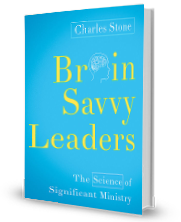
Book: Brain Savvy Leaders

BSL-181Leadership books are everywhere and have been for some time. They range from seriously deep to the farcical. It appears that everyone has a leadership theory, and so everyone has a book to write. The question for Charles Stone (D.Min, TEDS) is whether or not Brain Savvy Leaders rises above the clutter of the market.

First, let us examine his basic premise. Stone, who blogs extensively about the connection between neuroscience and ministry, tells the reader that the way the brain works is critical to understanding leadership. His premise is that ministry leadership should consider not only how their mind works but also the impact neuroscience has on their communication and their followers. I would note, positively, that Stone sticks with neuroscience as his term and not neurology—he is not a “neurologist” which is a medical specialty.

Along this path, Stone presents that we, as Bible believers, need not fear the science of the brain. After all, if the brain is part of how we are created, then learning about the brain furthers our understanding of how God made us. As we grow in that understanding, we are more equipped to work together.

From there, he goes on to present a mixture of Scripture and science, showing how the brain works and how that affects us spiritually. One of the more valuable sections deals with stress hormones and their overall effect on performance. To summarize, stress does have physiological effects on the brain which make it harder to make decisions. Even though we may feel like we make good decisions under stress, the truth is just the opposite. Cortisol is only your friend in crisis, and you need time to recover.

From a theological perspective, Stone’s analysis dovetails well with Scripture. He clearly recognizes the Bible as the top-line authority on what we do in ministry. This includes noting passages in the Psalms about rest and Proverbs about diligence, but tops out with the reminder that our purpose is to seek the Kingdom of God.

The concluding chapter provides a plan to implement Stone’s ideas. This practical addition moves the work of Brain Savvy Leaders from a theoretical exercise to a practical work. While this is not the first book I would hand to someone developing their leadership skills, it’s definitely a great “next-step” learning book.

Doug

Wednesday, June 17, 2015

Reflections on the Move Part 1

For those of you who don’t know it, our family recently moved. As in, 2 weeks ago today the big trucks rolled up and took everything away. We had lived among some of the best people we’ve known in Almyra for nearly five years. We left there owing many things to many people, from emotional debt to encouragement debt to the fact that I know (and still intend to repay) I still owe someone money. No, it’s not a gambling debt either.

We’re now in East End, Arkansas. Actually, we live in Landmark, Arkansas, though I’m fairly certain that doesn’t make us Landmark Baptists. The church we serve is in East End, creatively named East End Baptist. It’s from the time before groovy church plants like “The Verge” or the “Connexxion” or anything else.

The first reflection I want to make on the move, though, is this: it never gets easier. Ann and I have both moved a good bit in our lives. We’ve gone through relationship changes from it, and it doesn’t get easier.

In fact, that was one of the harder parts this time around. I’ve done this enough to know that half the people who you say (and even intend!) to keep in touch with, you won’t. Either we’ll drop the ball or they will. A few are guaranteed—I still have Eric’s truck, for example—but everyone else? It’s a toss-up.

The kids, though, don’t really understand that. Five years have covered a lot more of their lives, and they expect the “you’re always welcome here” statements to be true. They have no reason not to think that.

Here I sit, then, wondering how much cynicism I need to project onto my kids. We were in a good church, with a good church family, but given our Sunday commitments, it’s pretty unlikely we’ll be back during church. So what will we do?

We’ll do our best. We’ll keep communication open, encourage our kids to write letters and make phone calls. And keep encouraging them to make additional friends, not new friends. Additional friends enhance your life but don’t replace the ones you already have.

And for that, we remain grateful as we have additional friends and family in this community. Some we haven’t gotten to know yet. Some we’re just getting started with. But life is made full by the lives you encounter, the people God brings through your path. We’re committed to a full life in serving Him. So we look forward to the rest of this adventure.

Tuesday, June 16, 2015

Shepherds and Flocks: 1 Peter 5

In Summary:

Peter concludes his letter with some personal greetings (5:12-14), but not before giving final critical instructions. These open with a “therefore” in verse 1 as Peter charges the elders to shepherd well. In this section, we see the elders commanded to shepherd, and so is one place where we get the idea of “elders” as equivalent to “shepherds” in the church. “Shepherd” being a term that can also come into English as “pastor,” and we see this as addressing (partly) the responsibilities of pastors.

We’ll come back to that, though, in a moment. The next part of the chapter gives instruction to the younger men, which lends itself to understanding “elder men” in the earlier verses as those who are simply that, elder and more mature. The younger men are addressed as needing to move beyond their arrogance and worry, instructions that clearly should be followed by all of us.

Finally, Peter gives the general instruction to be of sober spirit with a warning about the adversary of God’s people. Fortunately, we are given the promise that the adversary will flee if we resist in faith. This should make it clear, though, that our suffering over things of this world is not guaranteed to go away—after all, we’d all resist that. Instead, resistance in faith supports our spiritual walk.

In Focus:

Let’s bring the focus back on the opening verses. Peter speaks to the elders about their actions in leading the church. For the sake of argument, we’ll stick with the idea that “elders” here speaks of a specific group of leaders in the church rather than just those who have been around the longest. I would suggest, though, that in a world where church participation is opposed culturally, legally, and traditionally, those who have been around a long time likely are the most committed and should be the leaders. Also, do not forget that Peter’s writing comes in a time where there would have been older believers who were actual witnesses of the life of Christ, which would even better qualify them for leadership.

That being said, take a look at the instructions to the elders. First, the ownership of the flock. It belongs to God, not to the elders. Likewise, fellow pastors, these are God’s people not ours. Our charge is to defend and feed—the Lord God will decide when it’s time to shear. Second, consider the the statement of “voluntarily” in our service. While there is something to the idea of calling, it remains that we could do something else. So we should dial down our “I sacrifice so much” jabber and work forward. Third, not “lording” it over. The Church of God has ONE Lord. It’s not your pastor. Even you, East End, the church I serve.

What has this to do with those who are not pastors? Quite simple: do not surrender to a pastor what belongs to God. And do not expect from a pastor what only God can do. Your pastor is not to lord things over you, but likewise you cannot expect him to solve every problem like a man with the power to enforce compliance. God’s people have to work together—don’t expect the pastor to save you. Jesus did that already.

In Practice:

1. Pastors, pray for your section of God’s flock and remember you are one of them. And feed them the Word of God.

2. People, pray for your section of God’s flock and your pastors. And feed on the Word of God so that you can recognize when your pastor is right and when he’s not.

In Nerdiness: 

Two things on the nerd side.

1. There is debate about whether or not “elders” and “pastors” are the same group in the church or not. This debate extends to whether or not any of these terms apply technically, that is referring to a specific group at all. They may simply apply to whoever is or does what the term means. There’s big debate on this. Grab a book or two and study up.


2. Note v. 12’s reference to writing through Silvanus. We’re fairly certain that this is Silas, and that Peter used him as a scribe for the letter. One question is how much Silas influenced the wording/structure of 1 Peter. Compare it to 2 Peter, for example. The other is how much Silas’ presence influence Peter in general.

Monday, June 15, 2015

Sermon Recap for June 14

Look! I’m on time this week! Bear with me while I straighten out a few last recording details. Quality should improve at points along the way.

Morning Sermon: Unconquerable Light: John 1:1-5 (direct audio)

Evening Sermon: Joshua 3 (direct audio)


Notes:

1. Next week I should have outlines back in place.

2. Still working on camera options. We are using the built-in mic on the camera, so it picks up some noise.

3. Once I figure out how, I’ll see about putting these directly on the East End Baptist website, but that’s down the road a bit.

Thursday, June 11, 2015

Sermon Recap from June 7

Yes, I’m running behind! Moving will do that to you.

Morning sermon: John 1:1 (direct audio)

Evening Sermon: Joshua 1:1-8 (direct audio)

I’m having some issues with the evening video—it should come up here soon:

Tuesday, June 9, 2015

Multi-site churches interview

This past weekend, I was featured on a radio show talking about multi-site churches. First, here’s the link: Up for Debate Radio.

Why did I end up on a program with a guy from 9Marks, given that they’re famous and, well, I’m not? It came from this blog post that I wrote on SBCVoices.com about 6 years ago. I’ll reprint my part below.

What was interesting about this was that I wrote the blog post to help spur the debate, not really thinking positively about multi-site churches. I still think the better way, and the more Bible-driven way, is individual, interconnected local churches. That is, there ought to be a real, live person preaching/teaching in front of real, live people. Otherwise, the temptation to celebrity or unaccountable pastors is too great.

That does not mean, though, that I don’t think there is a value in a multi-campus ministry. here are two thoughts on that, both stemming from the ministry in Almyra that I have just moved from.

First, pastors don’t always stay in one place. Maybe we should, but we do see Timothy and Titus going as sent, and so forth. What becomes of a smaller membership church when their pastor leaves? (Realize that even if a pastor stays put for 40 years, he’s going to die or retire.) There is confusion, lack of leadership, and so forth. If a church served by one pastor was part of a network involving multiple locations and multiple pastors, the departure of one would be softened by allowing another trusted individual in the network to fill the gap for a time. This would also allow for extended mentoring for new ministers that is just not possible in the current Baptist system. The difference between “Youth Minister in Church of 200” and “Pastor of Church of 75” is too great.

Second, pastors do not possess all the skills needed in a church. Out in the rural areas, we’re well aware that a small church has nearly every problem that a large church does. We just only have one of them. One person with PTSD. One person with drug problems. One child with special needs. One couple needing marriage counseling. And we’re frequently far outside the effective radius of referring these folks to the “big city” for more help. We just don’t have the connections to the right counselors or therapists.

Yet being a connected campus of a larger church would allow a smaller church to meet those needs with Biblical guidance far better. One counseling-equipped minister could be known by multiple congregations, one special-needs specialist could help equip multiple groups. And so forth.

I think it is far easier to do multi-site badly, even hideously, than it is to do it well. And it is too often done to safeguard egos and make more money—after all, preaching to 2,000 pays more than 200—and there is no excuse for that.

Overall, though, I think there may be something more appropriate about using smaller, distributed facilities than building megachurches. But that may just be me.


Here’s my half of the old post. It was a debate post, and I had the “pro” side. In the six years since I wrote this, the model has spread more in the US than I imagined would happen.

Multi-Site Churches: Why They Are A Good Thing

I have found the recent decade or so of discussion and emphasis on church planting in Baptist life a fascinating one.  I thought that we Baptists had a natural church planting system.  When you get mad, you start another church.  This has created, especially in the South, Baptist churches on every corner. 

Is this a good thing?  I’m coming to the conclusion that perhaps it’s not.  Why?  Well, for any decision in the church today, we cannot simply choose based on our preferences.  As Baptists, we claim that our churches are driven by Scripture, not solely by human ideas.  So, let’s examine what solutions Scripture offers us.

First, we do not see in the Biblical record evidence that there existed multiple churches in one city.  Peter or Paul traveled, preached, but only established one church in the places they visited.  The epistles of the New Testament are addressed to the church at Rome, Ephesus, Corinth, and the like.  So, we see that, Biblically, there are no cases of multi-church cities.

Second, we do see in the Biblical record that, Paul especially, but Barnabas also (Acts 15:36-41) felt a continued responsibility for the churches they started.  What became the second missionary journey actually started out as a church checkup trip.  Paul continues impacting the churches he started through his letters and through his dispatch of leaders like Timothy and Titus.

Finally, we have the example of Old Testament Judaism.  Although the exile led to the development of local synagogues, the initial structure of worship involved the central sanctuary of the Tabernacle and then the Temple.  While the Levites were spread throughout Israel, worship was centralized, first at Shiloh and later at Jerusalem. (Deuteronomy 18:1-8; 1 Samuel  1; 2 Samuel 6)

What does this mean for us?  After all, we have neither apostles nor Levites; we do not live in the Roman Empire.  How do we use these ideas in our days?  I see these Biblical examples as supporting the use of multi-site churches. 

A multi-site church is, essentially, a church that chooses to meet in multiple locations, generally, at the same time.  Preaching and sometimes music are simulcast or video delivered to the locations where the preacher is not.  Sometimes this setup is established in a church planting situation, sometimes it comes out of the intentional choice of existing churches.  While this setup has not spread like wildfire in America, it is becoming more known and more often, at the least, considered.

How do these Biblical examples support this idea? In these ways:

0.      The early church recognized the need for a central point of authority and direction for all believers.  This is best visible in Acts 15, but is also noticeable in the epistles of Paul.  After all, what do you think he’s doing when he writes to the Corinthians about church order? He is, while preaching elsewhere, trying to direct the affairs of another church.  There, we see that being on the scene is not crucial to knowing God’s intention for the situation.

0.      The utilization of one complete church in each city or basic area supported by the gifts and giving of its members.  Again, we see Paul write the Romans that there are many types of gifts (Romans 12:3-8) that should work together and 1 Corinthians 12 is our classic example of how the body operates through its diversity of parts, just as the Body of Christ ought.  By developing one church, without boundaries, that church would have the completed body at work.

0.      Various church teachers and leaders have differing specialties.  Some are gifted with marriage enrichment, some with various age groups, some with financial teaching, and others with parenting teaching.  Rather than developing a church on this side of town being strong with youth, and the church on that side good with senior adults, and thus dividing the body by age, the whole body can benefit from the skills and talents of all available teachers in the area.

0.      A word is due about the Great Commission in Matthew 28:16-20 and the command to make disciples of “all the nations.”  Unfortunately, within America, we still retain a highly segregated approach to our church activities and services.  A multi-site church should not, in ideal, focus only on one neighborhood or cultural group.  

0.      A word is also due about finding Biblically qualified leadership.  A debate could be had over the instruction that an “elder” be “the husband of one wife” in 1 Timothy 3:2.  Assuming it means non-divorced, our culture is leading to a rapid decline in the available pool of Biblically qualified elders.  Add to this the additional qualifications of managing a household well, being able to teach, and being self-controlled, and it’s actually remarkable that we can find enough pastors to fill the pulpits we have now.  By developing multi-site churches, the need to find excellent Biblically qualified leadership increases, but the number of positions to fill decreases, making it more feasible to fill those roles.

0.      A final word should be said about the pragmatics of the situation.  How many church buildings and administrative structures do we need to support?  While there are different costs related to the multi-site church, more study would be needed to determine whether this is a help or a drawback, it certainly bears consideration.  While there is no Scripture that flat denies using a multi-site church, there are certainly Biblical considerations of stewardship that matter here.

In all, I do not see a Biblical reason to avoid the multi-site church, and believe it is a good option as we go forward, seeking to spread the Gospel throughout the world.
Monday, June 1, 2015

Sermon Recap for May 31

Good morning! Here are yesterday's sermons;


Morning sermon: 1 Kings 18 (audio)


1 Kings 18: Five People

I. Ahab
     1. Does not recognize his faults
     2. Does not recognize the truth--returns to eating and drinking!
II. Elijah
     1. Knows the problem
     2. Does not know the breadth of God's people
III. Obadiah
     1. Serves the people and the king and the Lord God
     2. Who is his master? He greets Elijah as such, but Elijah refers to Ahab as his master
IV. The Prophets of Ba'al
     1. Fools. Damned fools, in the literal sense
     2. Mistake passion for truth
V. The people of Israel
     1. Floating, wavering

     2. Time to stop.


Evening Sermon: Jude (audio)


Thank you, Almyra Baptist, for allowing me the privilege to be your pastor.

Health Reflections Part 1

I don't know quite how many posts I'll put in the health series. I know I have some thoughts and don't want to put them all at o...