Monday, March 23, 2015

Sermon Recap for March 22

We had a guest preacher in the evening, so the records are only for the morning.

Morning Sermon: John 12:20-33 (audio)

Bulletin Outline:

Focal: 24-33//Burial and Baptism

1. The _______ of Jesus is compared to planting a grain of wheat (burial)

2. Jesus ______ was not only to atone for our sins but to show what happens in our  ________ (death)

3.  Burial of our current life is necessary for us to __________ what we are intended to be (become)

4. The glory of God is found in who He makes us to be

Monday, March 16, 2015

Sermon Recap for March 15

Beware the Ides of March! History gives us that Julius Caesar was assassinated on this date, 44 BC. This is one of the “major” events outside of the Bible that shaped the New Testament world. It’s not really relevant to the sermons. It’s just interesting.

Morning Sermon: John 3:14-21 (audio)

John 3:14-21

1. ____________ comes to Jesus at night (Nicodemus)

2. Jesus reminded him of the story in _____________ (Numbers 21)

3. Jesus came to provide ___________ from judgment (salvation)

4. Without believing in Jesus, everyone is ______________ judged (already)

5. Truth should be _________ (Practiced)


Evening Sermon: 2 Timothy 3:16-17

For those of you who do not attend, Sunday nights often have several components. That the sermon isn’t very long doesn’t mean there’s not a lot of patience in the congregation Smile


Concluding Notes:

1. I do have the rough audio of Sunday Night’s Q&A session, but I’m not sure yet that it’s useful for posting.

2. I am not sure how to improve video quality with the current equipment.

3. If you want to subscribe, here’s a list:

A. iTunes for audio subscription link is here.

B. General Audio RSS feed for other programs is here.

C. If you’re a Stitcher User, the link is here

D. For Youtube Video, subscribe here: https://www.youtube.com/user/dheagle93/

E. Some videos are up on Vimeo, but budget constraints have ended my posting to Vimeo for the time being.

4. Yes, I think I’m not getting a lot of plays on each service or hits on each blog, but in total it’s a decent reach. A social media expert might suggest changes, but this is free-to-cheap, where I have to live right now.


5. Each blog has a “Follow” button and a “Subscribe via Email” option


6. Follow on Facebook: Doug’s Page or the First Baptist Almyra Page

Friday, March 13, 2015

Blogs I Read Revisited

Way back in 2009--an eternity in Internet years--I did a brief blog post about the blogs I read on a regular basis. I took a look at it today. It's time for a new list. Interests change, people change, and the blog world moves onward. So, here are some blogs I read, categorized a little bit.

First, there is the one blog that I don't skip: www.annhibbard.com. I know, she's my wife. I also like how she writes and what she writes. She also is the main one to keep up www.thehibbardfamily.com, though I am supposed to be doing a little better at adding on to it as well.

Second, Ann works for the Home Educating Family Association. Their website is at www.hedua.com. At some point, the section labeled "Blog" may move, but for now, that's a generally good resource for homeschool stuff. In with the education blogs goes http://blog.drwile.com/, where Dr. Jay Wile posts fairly frequently on matters of science and education. Rounding out education, I'd put Dr. Robert T. McKenzie's blog at https://faithandamericanhistory.wordpress.com/ for matters of history and historical process. 

Over in the theology area (I am still a Baptist preacher) things have changed a bit. We moved about 18 months after the last update, and I don't keep track with quite as many of the preachers that I used to. Plus, there have been retirements and shifts in the broader world. I'm on-again, off-again with reading at SBCVoices. I still keep up with the Pyromaniacs Blog, though it's slimmed down some in recent years. Ann and I consistently enjoy Mortification of Spin, even if they do mock Baptists at times. Beyond these, I'm looking for some additional theology/Biblical Studies blogs to read semi-regularly. I do read Canon Fodder by Michael Kruger, Pajama Pages and a few other "look harder and check on your actions" types of blogs, but not every day.

In the writing and business arena, I've started tracking a couple of new folks. First is Steven Pressfield. Books and blog, I'm enjoying what he and his team are putting out there. Also, Shawn Coyne's work has caught my eye in writing. Overall, both Jeff Goins and Jonathan Milligan have good blogs. Milligan's blog is kind of fragmented across a couple of spaces, but it all comes from there. Of course, you won't go too far wrong with Michael Nichols and Michael Hyatt.

A lot of the friends that used to blog have kind of slid off into Facebook and Instagram, so there's not as much of that anymore to post. All in all, blogging has changed a good deal in recent years. Or at least it's changed in my dynamic. But these are the things that fill my Feedly.com reader...

Well, and of course www.altonbrown.com. Can't miss the food blog!

Wednesday, March 11, 2015

Blogs and Writing: An Interview with Jonathan Milligan

15 traits Book display with framework transparentI met Jonathan Milligan last year at a leadership conference in Texas. Since then, I’ve linked to his blog at JonathanMilligan.com and drawn from his wisdom in the EverFocus System. He has a new book about blogging and how to develop your blogging into more than a hobby.

Even those of us who are blog as a sideline or an extension of other habits can benefit from this work. I had the opportunity to send Jonathan a few questions, and he answered them and encouraged me to share those answers with you. Here they are:

profile pic 006

In the book, you start off by talking about the blogging pyramid of success. What is that exactly?

Over the years I’ve discovered that new bloggers want a step-by-step roadmap. More than anything they want other more successful bloggers to tell them exactly what to do. There are so many things you can spend your time on and what new bloggers fear the most is wasting their time. They don’t want to blog for a year only to look back and find out they spent their time doing the wrong things. The blogging pyramid of success is a one page roadmap that helps aspiring bloggers know where to spend their time. You can get your own copy at http://BloggingYourPassion.com

You make a point in the book that the difference between the successful and the unsuccessful is their mindset. Can you give some examples?

Sure. The more I’ve spent time mentoring other bloggers I find that their mindset slows them down more than anything else. How we think impacts our actions. If we doubt, we don’t ship. If we lack confidence, we don’t publish. Some of the more important mindsets include: patience, resilience, and passion. 

What advice do you have about blog post titles?

Blog post titles are super important. Think about it. You can have other sites rank higher than you in the search engines but if you have the more compelling title, they will click on yours. It’s also especially important when sharing your blog posts on social media. People will click on your link if the title is intriguing or interesting. 

If you could only give one piece of advice to a new blogger, what would it be?

Build your email list. What catapulted me from a hobby to doing this thing full time was a concentrated effort in growing my email list. For me, it’s more important that how many blog visits I get a day. We all want more traffic, but building an email list will help you develop those long term relationships. 

Is there a danger zone of chasing fast results compared to staying focused on passion during low-result times? 

Yes, there is a danger. We all want instant results. We want instant results so badly we will change strategies regularly and chase things we are not passionate about. At the end of the day, money will never fill your purpose bucket. You need to blog on things your passionate about in order to build an audience. 

Where can people better connect with you and learn more about this new book?

The best place to connect with me is over at http://BloggingYourPassion.com. If you’d like more info on the new book, the 15 Success Traits of Pro Bloggers, you can find out more at http://BloggingYourPassion.com/book


If you are looking to push your blog writing habit past something that just drains your time, look at Jonathan’s stuff. It’s worth it. Also, for those of you who like audio learning, check out his podcast here: https://itunes.apple.com/us/podcast/simple-life-habits/id565942255?mt=2

A few minutes at a time can really strengthen your approach.

Tuesday, March 10, 2015

In the Night: Luke 22

In Summary:

In the night, both good and bad happen. In the history of Israel, they were delivered from Egypt in the night (Exodus 12,) thus setting up the primary celebration of the Passover as a night-time event. This was one of the most important remembrances for the people of Israel

However, night was also the time when evil things happened. Historically speaking, prior to easy lighting, most cultures avoided nighttime activities. It was impractical to have light enough at night to do anything useful.

(An interesting anthropological study would involve how night-aversion is different in cultures where the buildings aren’t as confined, like one finds in tropical cultures. I digress.)

Most of Luke 22 happens at night. The opening 13 verses summarize events that occur prior to that night, but even these are feeding into what occurs in the night of the Passover celebration.

In Focus:

Take your magnifying glass to Luke 22:24-34 and look at the disciples and their argument. What is the argument? Same old stuff: Who’s the greatest? Or, more clearly, who is the most important? It’s an argument among them regarding their own rights and privileges. I think one can look at v. 26 and see that part of the underlying issue was the cultural expectation that the younger were expected to give way to the older, by virtue of age only.

Further, Jesus goes on to highlight the Gentile practice, especially among the dominant Roman system, of expecting to be noted for using authority. In that system, the ones in power expected to be called “benefactors” or other positive terms, even as they used their situation for their own improvement. It’s not unlike the modern reference to the politicians in Washington calling themselves public “servants” when the goal is get re-elected and line their own pockets—the only “service” is to further themselves.

Jesus instructs that the disciples are not to copy this system, but to serve. He goes on to point out that the ones who thought they were strongest—ones like Peter—had only been strong because of His support. The key here is in vv. 29-30, where Jesus grants the Apostles the right to sit at His table in the Kingdom. This is the highest honor one could experience—and so, there is no need for them to chase earthly recognition and privilege.

In Practice:

Practically, this gets a little hairy. First of all, it’s easy to get into a “serving-to-lead” mentality, where we serve for a time in expectation that we will be lifted up into something greater. That motivation is seen by God, and even if we accomplish that goal, we need to realize it’s not the way to approach life. Second, there are appropriate ways in which we should honor the ones who have gone before us, and respect those who do lead. This should be freely given, though, and never sought. Third, we like our privileges. Many times, it appears that we would gladly serve as long as we still get the comfy bed at the end of the day. That’s not how it works.

I would note, however, the difference in spiritual community and employment. Your boss gets to tell you what to do. He’s the boss. She’s the commander. Whatever the case may be, there are venues in which leadership *is* positional and absolute.

How does this inform our behavior? First, we set aside our ambition. Not our desire to work and accomplish, but our ambition to be important. Our ambition for recognition. Second, we put on deliberate service. Look hard for the little tasks, the behind-the-scenes things that have to happen. Do them. Third, forget you ever did them. Your recognition is not that now people will listen. It is that it will be granted to you to sit at the table in the Kingdom.

Now, the other side is this: look for the people who are serving. Pay attention to them. Ask the opinion of the people who are quietly dependable. There is likely more wisdom in them than in many visible people.

In Nerdiness: 

We get a fun nerd discussion when it comes to the timing of the crucifixion. John indicates that Jesus is crucified while the Passover is being prepared, while Luke here suggests that the Passover meal happens the night before. What do we do with this?

A few possibilities exist. One, that there was a multi-night observance of the Passover, is certainly plausible. Another, that John tweaked a fact to make a point, seems less likely in light of the inerrancy of Scripture. I think he presents a theological biography in context, meaning some events may be shifted in order, but to muff an actual fact is beyond that scope.


In considering this, remember that some of our understanding is traditional more than Scriptural. It is clear that there was a “holy day” after the crucifixion, one that could be termed a “sabbath” without being an actual Saturday. We also know that the Jewish people counted a day as beginning at sundown. It’s possible the solution is in there, somewhere. Study up and see what you think.

Monday, March 9, 2015

Weekend Reflections

This past weekend, we celebrated 39 years of life for my beloved wife, Ann. We are blessed by the fact that most of what we enjoy, we get to do for a living—she works in the homeschool community and writes, I teach the Word of God and write—so “taking a weekend off” is a different sort of thing for the two of us. We’ve had years where we had to get away from work and life…we’re not currently in those years.

That being said, there are still the day-to-day details that it’s nice to escape. The alarm clocks. The telemarketers. The cat who is living on some weird time zone wherein “you get in when we get up at 5” means “start banging on the door at 3 just to make sure she’s not forgotten.”

We started the weekend off by heading up on Petit Jean Mountain in Morrilton, Arkansas. It’s a lovely part of this state, and the partial snow covering was an added bonus. We had saved up our vacation money to take part in Table for Two at the Winthrop Rockefeller Institute (again). This time around, we made honey-pecan pork cutlets and talked a lot about bacon. All in all, it was a lovely and relaxed time.

Saturday we made our way back to Little Rock, taking back roads and following a wandering path to get there. It was a pleasant time of testing our sense of direction—of course, there was the GPS safety net in the back of the car if we needed it—and meandering through some towns in Arkansas we had never been in.

Sunday saw a relaxed morning, a good lunch, and a safe trip home. It was just the type of weekend that would make some of you crazy. No agenda, no plans, no nothing—after 5 PM Friday, when Table for Two started, we had no appointments to keep.

It fit our needs, though, as well as our personalities. That’s one of the joys of 17 shots at celebrating Ann’s birthday. I think I’m finally getting the hang of what she likes!

Plus, it’s good to be reminded that work can live without us—even when it’s work we love.

Is it something we would do every weekend? No, not really. The chaos calls to us, plus normal life needs to be lived. Nobody should live on vacation while others carry their responsibilities. And others did have to carry our weight for the weekend.

I would encourage every one of you, take some time to recharge. Maybe you just need to turn the ringers off on your phone, pull the battery from your cell phone, and read a book all afternoon once a month. Maybe it’s something else entirely. But take a little time. You will return fresher and more ready for the challenges ahead.

Thursday, March 5, 2015

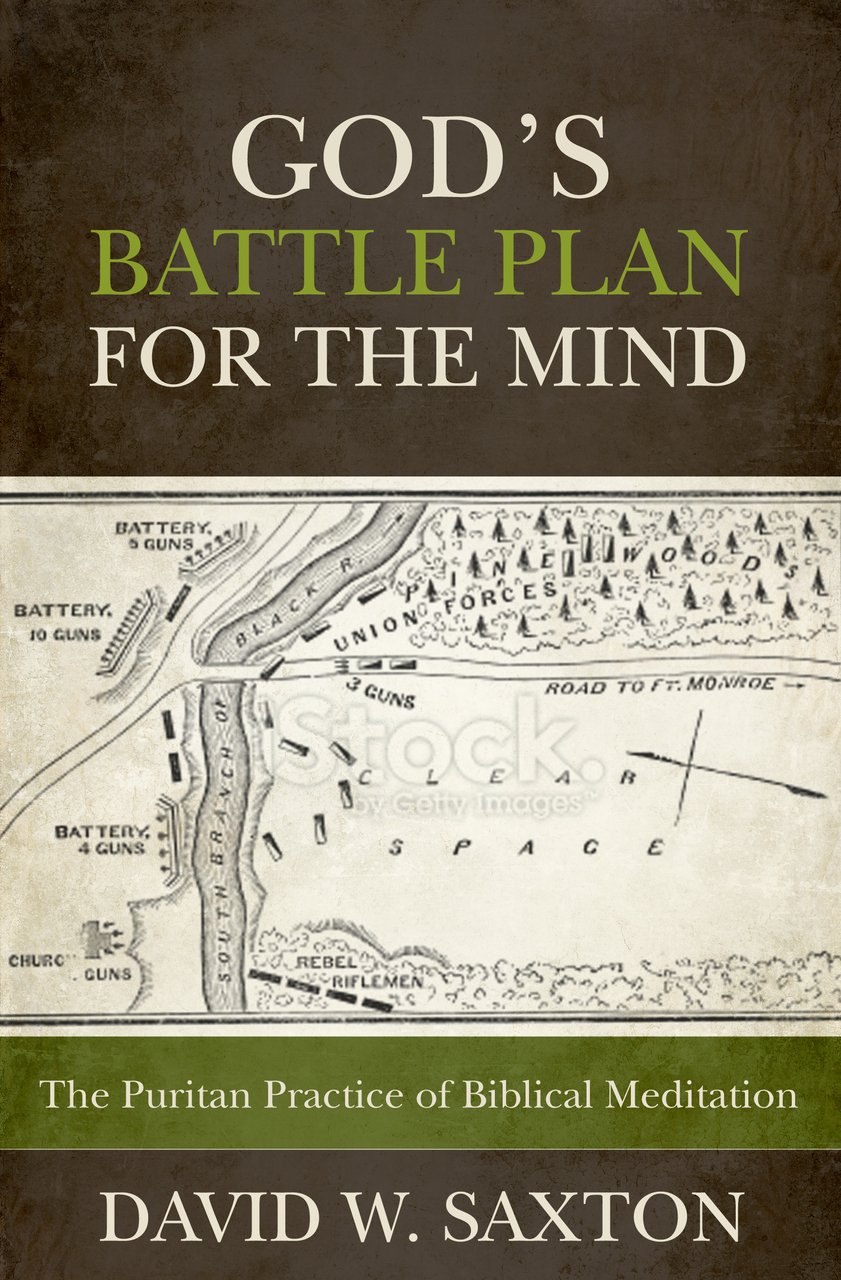
Book: God’s Battle Plan for the Mind

<-In the interest of honoring my commitments, I’ve got a book for you today. Regular blogging returns next week.

“What do you think about meditation?” is one of those loaded questions in some Christian circles. While one can readily find the word “meditate” in most English translations of the Bible, the multi-cultural setting of America causes us some difficulty in determining just how to put that word into practice. Meditation, as a spiritual practice, lacks a single meaning.

Into that debate comes David W. Saxton’s God’s Battle Plan for the Mind. The subtitle, “The Puritan Practice of Biblical Meditation,” gives you the value of the work. He provides the historical concepts used by the Puritans when they “meditated,” allowing the reader to properly understand where that practice fits with some modern suggestions of meditation.

Overall, the Puritan concept of meditation is much more active than many ideas put forward today. Saxton presents the idea of an intentional process of reflecting on the content and context of Scripture, followed by an active effort to determine application to life.

I like this book as a personal study tool. The often-wordy Puritans are summarized well, fitting with the reading needs of the more hurried days we live in. Further, modernized language makes them more readily accessible.

This is certainly a bigger answer to “What is meditation?” than many people are looking for, but if you are willing to invest a little over a hundred pages, the answer is here.

Free book in exchange for the review.

Book: Human Raised

Human Raised Nurturing Connection, Curiosity & Lifelong Learning in the Age of AI Dana Suskind, MD 310 pp., hardcover Dutton, an imprint...