Wednesday, October 1, 2014

Pulpit Freedom Sunday 2014

In the last five years, a trend has risen of pastors deliberately poking the IRS bear. This trend began with Alliance Defending Freedom offering free legal aid to any church threatened by the IRS over their action, so more and more are taking ADF up on the offer. First, perhaps some background.

Going back to the 1950s, the law in the United States establishing income tax regulations and exemptions for non-profits has had a section, called the Johnson Amendment, that requires non-profits to avoid direct political participation. This was intended to prevent religious groups from using their tax-exempt status to politically fundraise without having to deal with election law. It was also authored by a Senator who had just barely won re-election and had been consistently called out for sinful and unethical behavior by churches and pastors in his home state. Lyndon Johnson, upon his return to the Senate, then made sure the tax laws prohibited churches and pastors from directly attacking him again.

Now it’s the established law. Oddly enough, the IRS has had more trouble from the atheist activist groups over non-enforcement of this on churches (and other religious groups) than the IRS has spent effort in enforcing it. That I am aware of, there has only been one application of the Johnson Amendment in recent years, and that was a one-year denial of tax-exemption for a church. It has been a paper tiger—atheist activists want it de-papered. They want churches investigated. Oddly enough, the ADF folks want the same thing.

Both groups want the IRS to come down on churches for political campaign involvement. Atheist groups want to make sure it stops, and the ADF wants a case they can take to the Supreme Court, believing that the IRS, and the Federal Government in general, has no grounds to muzzle the speech of churches and religious organizations. Their position is that a church (or religious group) is tax-exempt by nature and that the First Amendment protects our right to say whatever we want, so the Johnson Amendment needs to go.

The ADF just wants to find pastors who are willing to preach directly on politics and dare the IRS to sanction them. The IRS has not played ball for the past several years, simply letting it slip (apparently, they’ve been busy losing emails and audit-targeting conservatives) and hoping the issue goes away. Atheist activists have noticed, though, and have sued the IRS to force them to enforce the Johnson Amendment.

The IRS has promised to do more about enforcement, even allowing a few activist groups to give them information about where it needs enforced. I triple-dog-dare a few of them to make sure their list includes as many liberal non-churches and Muslim mosques as it does Christian churches and Jewish synagogues. I digress.

Enter the publicity for Pulpit Freedom Sunday 2014, slated for October 5. And enter the question: “Doug, are you going to preach on politics this Sunday?” (Yes, real question from several real people.)

The answer?

I preach on politics every Sunday.

Because I preach the Word of Almighty God. The Word of God transforms us, as Jesus works through His Word in the Bible to conform us. And that should have a major impact on our politics.

Now, am I dodging the question? Will I endorse a candidate from the pulpit?

I will not endorse a candidate while preaching a sermon. Not at all this year, and not likely ever.

Why?

I am vehemently pro-life. In fact, if you are reading this blog and considering an abortion, I urge you to reconsider. And to use the contact info to send me an email. We will rearrange this house and you can live with us until you have your child, and if you still don’t want that baby, we’ll take her/him and raise her/him as one of our own. And I preach that—and our church does what we can through groups like the Hope Women’s Center to help out.

I am strongly pro-freedom, including the right to be prepared to defend freedom from all enemies, foreign and domestic. I have preached before on the need for righteous treatment of the stranger and alien (one comes from other countries..the other comes from ? ) I have preached and will preach on dozens of other issues.

But to pick a candidate? Let’s examine that:

For Governor of Arkansas, we have the choice between Mike Ross, career politician (by now, honestly) and Asa Hutchinson, career politician. Both have records that include good votes and bad votes, party-line behavior and independent-minded behavior. Because Governor Mike Beebe has behaved in this campaign as if he has the right to anoint Mike Ross his successor, I find Hutchinson less onerous than Ross. As much as a stick in the eye to the sitting politician who thinks dynastically as any other reason.

For Senator from Arkansas, we have the choice between Mark Pryor and Tom Cotton. One has a long record, filled with cronyism and party adherence. The other has a short record that he hasn’t had time to fill with cronyism. Cotton I find less onerous because he’s not the incumbent—and Pryor’s votes to confirm certain people have been pretty awful.

Should I take the message time of a worship gathering of God’s people and proclaim that “Thus sayeth the Lord: vote for this guy who is less onerous than the other one.” ?

I think not. I am not afraid to tell you here who I will vote for, and may develop other reasons to explain them. (Who isn’t my point here.) I am not afraid to say in discussions around church my political leanings.

But the pulpit?

You see, I do not believe I have freedom from the pulpit to proclaim that God has commanded certain candidates. It is not the IRS that I fear when I step up there—I’ll gladly point out that taxation through confusion and compulsion is wicked—it is the Lord God Almighty.

Should I take the opportunity, rare that it is, to speak to the flock about the Word of God and give them something that is not there? True, the fact that many Christians give 1/336 of their week to learning the Word of God is a major discipleship problem, but will I solve that by endorsing Leslie Rutledge for Attorney General of Arkansas?

Not likely.

Will I address someone’s greedy by endorsing a candidate or proclaiming what the Word of the Lord says about wealth? Should I preach for a legal minimum wage hike or for the employers in my hearing to do righteously for their workers because it is right in the eyes of the Lord?

Will I fix broken homes by endorsing candidates? Stop drug problems by recommending legislation?

I believe that the Word of God is the right solution—not the platforms of either major party in this country.

My freedom to preach is limited, but not by the IRS. It is limited to preaching those plain truths of the Word of God, to working to make disciples. Do I think that being a disciple informs how we vote?

Absolutely. But woe be unto me if I tell someone that voting for a candidate makes them a disciple.

For I am constrained to proclaim the Word of God from the pulpit.

I have that freedom in this nation by the grace of God and the sacrifices of millions, and I will not disgrace either by using it for anything less than proclaiming God’s glorious truth.

Tuesday, September 30, 2014

Sermon Recap from September 28

In all honesty, this past Sunday I did not communicate as clearly as I would have liked. I have identified at least one cause, in terms of focus, but part of why a church has a regular preaching ministry is because some sermons are not awesome. Some you get through and say, well, I think I was faithful to the message.

Then you do better the next week.

Sunday Morning: Malachi

Sept 28 AM Malachi from Doug Hibbard on Vimeo.

Sunday Evening: Luke Begins

Sept 28 PM from Doug Hibbard on Vimeo.

Monday, September 29, 2014

Quick Update for This Week

As much as it pains me…I will get the sermons uploaded sometime soon, once Vimeo gets them online.

Otherwise, it’s finals week. If you saw the update a few days ago, you know this will be the last finals week for a while, but because of wrapping up the term, I’m laying off the blogging this week.

Thanks for your patience, and I’ll be back next week!

Friday, September 26, 2014

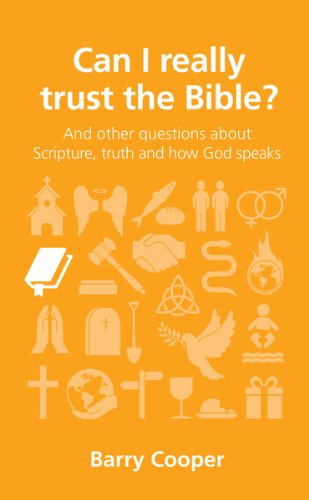
Book: Can I Really Trust the Bible?

Today’s book—>

For those of you in Almyra, no, that is not the same Barry Cooper that we all know and love. I know how that Barry Cooper answers the titular question. He says “yes” and the moves on with the day.

I was provided a copy of this book in exchange for the review.

Christianity as a religious faith rises and falls on whether or not Jesus is real, and whether or not He is really risen from the dead. Given that theological assertion, though, our knowledge of Jesus rises and falls on whether or not we can trust the Bible to teach us about Jesus. If we cannot trust the Bible, then we really don’t know much about Jesus at all.

Into this discussion come some really weighty books. Seriously, by the pound weighty books. And then comes Barry Cooper’s Can I Really Trust the Bible? which is a relative lightweight in the discussion. Why? Because it’s short.

Not as short as a fundamentalist work would be: “Yes.” But short, nonetheless. He produces a slim 80 pages, with easily readable font, to address this question.

His argument begins from a point of faith declaration, showing that His start is with the text of Scripture being, well, Scripture. Then he moves on to explore evidences for the trustworthiness of the Bible. He also references Winnie the Pooh, which is almost always a positive for me.

Cooper provides basic responses to the most common questions about the Bible, including what is the internal evidence for Biblical trustworthiness? What are external evidences?

It is true that some of these answers are more simplified than some works are, but it’s still a very good first-level book. I’d recommend it for church study groups and individual growth. Makes a great stocking stuffer, too, for the budding Bible nerd in your life.

Free book provided through Cross-Focused Reviews for the GoodBook Company. I liked it.

Thursday, September 25, 2014

No Math! Deuteronomy 12

In Summary:
Briefly, Deuteronomy 12 presents the second helping of the laws of God related to public worship. The old pagan structures are to be destroyed, new worship is to be done in accordance with God’s commands.

Notice, especially, the statements about how: 1. You shall not act like this toward YHWH, your God; 2. God’s choice of worship—the place which YHWH will choose; 3. Tithes in 17-19, that were to be used for fellowship, rejoicing, and feeding the Levites.

In Focus:
I have one, clear focal point in this passage. Take a look at Deuteronomy 12:32. (For you Greek nerds, it’s 13:1 in the LXX, also in the BHS for you חֶברֶו types.)

Take a good look. Especially that last phrase: you shall not add to it or take away from it.

God is abundantly clear that His commands are to be followed, and even more clear that they are not to be added to by people.
In Practice:
What matters in practice of this?

In summary, legalism. In all sorts of forms, legalism keeps cropping up. It is the Hydra of Christian practice, that when you cut off one head, two more take its place. Cut it off, here and now, and singe it with the fire of the Spirit.

How does Legalism keep springing back? Take a current, massively destructive debate in Christianity about education. Here’s legalism at work in three easy statements:

A. Those who do not homeschool their children are handing them over to Satan and dooming them to destruction.

B. Those who do not send their children to government/public schools are abandoning their communities and dooming all the lost of their community to destruction.

C. Those who do not send their children to private schools are dooming their children to lousy education, lousy social skills, and destruction of their spiritual well-being.

All of those statements are legalistic. They do not take into account the freedom in the Spirit to make wise, discerning choices about parenting and education.

Have another issue we are constantly lobbing rocks about, that of family responsibilities. Here are three statements on it:

A. Women who work outside the home abandon their God-given responsibilities to the home, and it should never happen.

B. Women who never work outside the home are trapped, and often deluded into thinking they are not trapped, by men whose only purpose is control.

C. Men whose wives work outside the home are less than real men.

Again, we are not allowing people the freedom to make their own decisions based on their understanding of the Word of God.

And God’s Word is not as crystal-clear on these matters as advocates on any side would like you to think it is.

This violates the principle stated here, to not add to the Lord’s commands. Yet sometimes we are so obsessed with what we think His commands are that we keep piling on to them, and then we extend them to everyone else. For example, Ann and I are convinced that in our situation, the wise choice is to homeschool. I will not detail all the reasons here, but we feel that we are being obedient to God’s commands in doing so. However, we know others who utilize both public and private options for education. And they are being just as obedient as we are.

Likewise, Ann works for an outside company but she works from home. I am not unmanned by this nor is she abandoning anything by working. She would not be abandoning us if she went to a local Internet cafe to work. There just are no local cafes.

Other families make other choices, and we are in no position to condemn their choices. Especially without knowing them! Now, if you came to me as your pastor and detailed a laundry list of family, work, and school issues, I would heartily recommend you make different choices. I have no fear of that. But I will not issue a blanket statement about any of these because I see that Scripture does not permit making any of those options the absolute Word of God. Why?

God did not make it the Word of God. I am not in a position to correct His choices.

The extension on this: if you are hearing from a preacher, teacher, or so-called ministry that insists that the Word of God must extend to include their view, their vision, to the exclusion of all others—that person is wrong. Based on Scripture. (Now, this caveat should not be necessary, but obviously some things are out-of-bounds and it’s not legalistic to say so—there are practices of pagans to be eschewed, just as the Israelites were told.)

Get out from teaching like that. Find help, find support, and get away.

Because the Law of God is very clear that there is no more math: no addition, no subtraction. He has spoken, and we act on it.


In Nerdiness: I’ve got nothing nerdy to add. It is plain here, and there is no wiggle room. Want to get nerdy? Wrestle with why the original languages have 12:32 as 13:1…or why English has 13:1 as 12:32, whichever you’d like.

Wednesday, September 24, 2014

Wednesday Wanderings: Nehemiah September 24 2014

I have, in the past, preached through Nehemiah. Those posts are archived back in January-February of 2012, but they were when I used a different podcast host and the audios of those messages are gone. All that's left are rough outlines. If I can ever find the original audios, I'll put them on the new host where they can live forever.

Until then, it's all gone. Rather than link back to that, I'll give a rundown of the highlights of Nehemiah, along with my questions going through this again. An observation worth noting: reading back through these passages again, a little quicker this time, I see some things I saw before, and other ideas do not show up as clearly. Meanwhile, a new thought or two also comes along.

First, I would note that Nehemiah was doing fine in his life. He's cupbearer to the king, which is a pretty tough gig to get. We have overplayed that in our cultural context to be the guy who is supposed to taste the king's food and die if it's poisoned, but it's really different from that. Think head butler/domestic staff-boss. Nehemiah has responsibilities for the king's household--including security. He is trusted and likely well-compensated for it. 

Second, I would note that nowhere in the opening chapters does Nehemiah have a prophetic call experience. There are no moments of grand visions or flying angels. Instead, he hears of a need. His heart is moved by the need. His intelligence reasons that he is able to aide that need. He finds there is nothing ungodly or against Scripture in meeting that need.

And then he acts.

Practically speaking, how many times do we wait for Isaiah 6 when God is working in our lives through Nehemiah 1?

Yes, Nehemiah prays and fasts before he acts. But he does not behave as if he is working from some grand prophetic scheme. It's a practical plan, a practical action. We need a few more Nehemiahs in our day, who will have a plan, make sure it is God-honoring, and act on it.

Third, I would note Nehemiah's willingness to take a risk. He goes before the king, admitting his problem and asking for help with it. The king is pleased to do so, though I might add that "if it please the king" is a permission-seeking formula, so "it pleased the king" may not reflect the king's "pleasure" so much as his "permission." Still, the king could have just as easily sacked Nehemiah.

And in a wandering moment...what is the chronological relationship between Nehemiah and Esther? If Esther is Queen alongside Xerxes I, then Artaxerxes is one of the king's sons from a different wife. If we have Ahasuerus of Esther misplaced, and he is one of the Artaxerxes (there's several), then could the "queen sitting beside him" in Nehemiah 2:5 have been Esther? That needs a serious nerd-look.

Fourth, I would note that Nehemiah takes time to address serious questions about his work, and deals with the legitimate objections. He has no patience for those who simply oppose him, and I think it is because he has had enough interactions with them. Tobiah and Sanballat were likely known to Nehemiah, nd we cannot argue from the shortness of exchanges in the text that this was the only interaction this group had. After all, Nehemiah is appointed as the de facto governor of Jerusalem. He's going to be aware of significant political people in the region, and certainly the leaders of other provinces, which it appears these opponents are. There are no grounds to automatically dismiss critics based on Nehemiah--not until they've run their course too far.

Fifth, I would note Nehemiah's acknowledgment of his need for God while still doing all he can. That should be enough said.

I like Nehemiah. He's practical and does what is in front of him--and often gets shorted in our list of Bible heroes. But the city he rebuilds? Jesus walks in it. 

That's pretty glorious.

Tuesday, September 23, 2014

Book: Being Church, Doing Life

Image<----Look! It’s a book! Well, it’s a book cover picture. But you get the point.

In Being Church, Doing Life, Michael Moynagh pursues the answer to this question: what does it look like when we separate church as “worshiping community” from church as “cultural activity?”

Because let’s face this up front: in many places, especially Moynagh’s United Kingdom and my United States (the Southern part!), church is endemic to culture. It’s just there. We have churches, we have churches everywhere. And there are cultural constructs connected to the idea.

Yet decades of cultural evolution have resulted in a cultural church that is not quite the same as what a worshiping community would look like. So, how do we sort out the differences?

By analyzing examples, primarily drawn from the UK but some from the US, Moynagh presents many non-traditional looks at worshiping community structured around the normal beats of life. These ideas are naturally inspiring, and should challenge us to think outside of the box.

I like his concept of developing witnessing community alongside Christian community. This is a great slice into how I have been asking the question for several years: is the one hour we meet on Sunday morning intended to strengthen the believer or reach the nonbeliever? It is difficult to do both at the same time with any faithfulness or completion.

Moynagh here emphasizes the development of the “reach out” aspect of community. I would suggest that this hinges on an assumption that people will move from reach-out community into Christian community where deeper questions and different problems are addressed; after all, some issues do not surface until one is actually trying to follow Jesus.

In this, I think there is a clear risk that someone will take Moynagh’s book as if it is the only path for all churches to follow. That is not on the author—it’s on the reader to balance Moynagh’s emphasis with a completed Biblical ecclesiology. As an aside, Moynagh stresses that Jesus didn’t write a book but formed a community. Yet he writes a book—and has written several. That makes this statement a line that has emotional punch but has no value. If books are bad, then why be an author?

Building on that statement as an illustration, what I find as the major concern here is Moynagh’s general de-emphasis on Scripture. While he routinely points to verses, he still pushes a bit toward the shallower side, as if a drop is enough to fill the bucket of a soul. I’d suggest that it’s not, but I will also state this: I don’t think Moynagh’s out to produce a complete text on all the aspects of church here. I think he has highlighted one facet of a diamond.

As an illustration of that facet, this is a good work, and one I would recommend. Especially among those of us who are in stabilized situations where the church is swimming along without turbulence, and needs to reach out differently. This will shake up the viewpoint.

But realize that the ideas here truly depend on having a deeper community to draw people into, whether it looks like a traditional church or not.

I think it’s worth your time as a pastor or church leader.

FOR THIS WEEK (9-22-26) ONLY! CLICK THIS LINK FOR A DISCOUNTED EBOOK PRICE FOR BEING CHURCH, DOING LIFE:

Image

Free book from Kregel Publishers for the review.

Book: Human Raised

Human Raised Nurturing Connection, Curiosity & Lifelong Learning in the Age of AI Dana Suskind, MD 310 pp., hardcover Dutton, an imprint...