Tuesday, October 8, 2013

It’s not my fault! John 9

At the present moment, the United States government is basically shutdown because the President and the Congress cannot get along. I will not attempt to parse the exact problem, because I am almost certain that if you read this five years from now, the first sentence will be nearly accurate. Even if it’s not the budget-type of a shutdown, it’s still going to be gridlocked.

The big question is always this one: Whose fault is it? Who is responsible for this mess?

That question, though, is not unique to the United States. It is not unique to the western world. It reaches back, truly, to the Garden of Eden, but we’ve already done that. Here we have a different question. A man is suffering: he is blind, in a world without any real support for someone with that challenge.

And the disciples want to know from Jesus: Whose fault is this? Is it his? Or did his parents cause this?

Jesus, as can be expected, responds to an either-or question by taking a third option. Now, there is much here to address the existence of evil in the world, how some of the suffering we see is caused by our sin, but much of it is so that we can see the glory of God. Much of it is so that we have the opportunity to be a part of the glory of God in relieving it.

Yet something else strikes me in this passage. The disciples here make for great students of religion. There is a situation in front of them, and they want to discuss the theological ramifications of it. Here is, after all, a perfect chance to learn about the way the world works. It’s like a case study. Excellent!

We do the same thing, don’t we? We look at the news and see civil war in Syria and wonder, “Who are the good guys?” We examine immigration and parse the finer points of economics and border security. We debate government-mandated health insurance and marvel that the US hasn’t done what other countries that are going bankrupt have done for years.

In our churches, we get into the same discussions. Here’s a teen mom—what failed that she finds herself in that situation? Here’s a divorced man, an abandoned child, an unemployed father, an abused wife. And we want to figure out the causes. We discuss the ebbs and flows of fortune, and then we think of the policy we ought to have about such issues.

At the end of the day, though, the answer is not about whose fault it is. I know that we need to find systemic solutions to systemic problems, that we must both teach people to fish while feeding them fish.

I would suggest, though, that we must also do as Jesus does here: cut off the debate and help the person in pain. The disciples barely notice him, except as a teaching tool. Jesus sees him as a person in need.

How do you see people? When you see that rock star in trouble with the law? When you see that kid in trouble with the law? When you see that deacon fail?

Rather than looking first for your theological point, look at the person.

Do what you can. Then, as the situation cools, analyze it and learn what you can.

But do not overlook people in your rush to determine if it’s your fault or not. Because if you leave him blind, hurting, hungry on the road while you check your algorithm?

Then it really is your fault.

Today’s Nerd Note:

Take a look at John 9:24 and the command of the Pharisees to “Give glory to God” as they question the not-blind man. Now, take a quick look at Joshua 7:19.

This was a charge to the man to tell the truth. A few takeaways:

First, the truth brings glory to God. Deception and lies do not.

Second, the two Scriptural instances of this phrase come from interrogations regarding sin. Both involve known realities: it is known in Joshua that Achan sinned. It is known here that the man can now see. There is nothing left to debate, really.

Third, both uses seem to indicate an idea of telling the truth to clean your conscience, not to escape trouble.

Fourth, both uses show people asking questions that they think they already have the answers for.

Finally, is there cause to think that the Pharisees deliberately harken back to Achan and Joshua? It seems, generally, that the Pharisees were concerned that individual sins would bring down the nation as a whole, so are they putting the not-blind man in that same boat?

Monday, October 7, 2013

Sermon Wrap-Up for October 6

My apologies for the morning sermon video. The camera I use is limited to an exact recording length, and I overshot that by a couple of minutes. In self-critique, I can see where I lost those minutes earlier in the sermon, but I can’t fix that now. Hopefully, there is still some value in watching it. The whole message is present on the audio.

Morning Sermon Audio link is here:

A Smashing Faith: Judges 7:19 Oct 6 Almyra FBC

Morning Video:

Morning Outline:

October 6 AM A Smashing Faith Judges 7:19-23

Almyra FBC

Setting of the Gideon Story

Points:

1. The gathered threat

     A. To the faith

          1. Philosophies

          2. Religions

     B. To the faithful

          1. It is more likely that we are at risk than the Gospel message

          2. Martyrdom is to be respected, not pursued

          3. Stand for your fellow believers

2. The firm faithful

     A. Never as many as you'd like

     B. Always as many as you need

          1. Not to attain the result you planned

          2. Nor to attain, always, the result any other expert would present

     C. Must be willing to trust

          1. You must trust the faithful

          2. The faithful must trust you

          3. Do not allow the faithful to evade their calling

3. The bizarre plan

     A. Not to fight flesh and blood

     B. To let light shine

     C. What is the weapon?

          1. The Sword of YHWH!

          2. Which is? Ephesians 6

4. The moment of truth

     A. Smashing the jars

     B. Shining forth the light

     C. Signaling your commitment

Evening Audio is here:

Worship Acts! Judges 6 October 6

Evening Outline:

October 6 PM Worship Acts Judges 6:11-27

Almyra FBC

Point: Those who claim to have an encounter with God do not spend all their time talking merely about that encounter. They rise up and take actions based on that encounter.

Having been in the presence of God is not a lightweight experience

Friday, October 4, 2013

Singing Vegetables and Congress


This video illustrates the thinking in Washington, D.C., right now. The Democrats and Republicans think there's only two choices, and refuse to admit any other possibilities.

It's funny when it's a tomato and a cucumber. It's stupid when it's grown-ups.

Thursday, October 3, 2013

The Bitterness of Death: Numbers 20

According to Benjamin Franklin, there were only two certain things in life: death and taxes. While Numbers opens and closes with a census, which is about taxes, Numbers 20 is about death.

In the opening verse, Miriam, sister of Moses, dies. She had survived the Exodus and gone through the entire period of wandering in the Wilderness. Now, as the people are lining up for the final march to the Jordan River, Miriam passes away. The dearth of information is stunning here. She gets one sentence about her death and burial, and then we go on.

We go on to find the people of Israel grumbling. Let’s keep in mind that this is the generation that has been raised in the wilderness because of the preceding generation’s unfaithfulness! Yet they grumble because there is no water where they are.

This is the first part of the bitterness of death: Moses and Aaron, leaders of the people, are not granted space to grieve. The needs of the people outweigh their need for time and a little space. And this is not unlike what faces many grieving people today.

Consider this reality: a loved one dies, and your company policies give you a few days off work. Yet what happens? The world keeps going. You take a day or two to be with family, attend a funeral, and the whole time you have to wonder what’s happening at work. No, you’re not being replaced, but you are being bypassed.

No time is given for you to grieve, because the world moves on. You have to keep up, just as Moses and Aaron have to in this chapter.

The people grumble about Egypt, a land they hardly even knew, and long to return to it. This is not unusual: how many people pine for days gone by without knowing what went by in them? I think of my contemporaries who long for the days of the Puritans without thinking much about starvation—or about what would happen to them if they were counted as dissenters in those days.

The people, though, want water. Since they want water, Moses takes this up with YHWH, who commands that Moses speak to the rock in the area, that it would bring forth water. Moses, for the first time we can see in Scripture, disobeys God’s direct command. Instead of speaking, he strikes the rock.

Much theological discussion has taken place about just exactly why it was wrong for Moses to strike the rock. Was it because the rock was struck twice? Was it this or that?

While the nerd-side of me loves this stuff, it’s really a nonsensical question. Let’s rephrase it to see why: “What made Moses’ disobedience to a direct, divine command from the Almighty, so bad?” Do we really need to answer that question or is it not clear in itself? Seems clear to me.

The chapter ends with the death of Aaron. Moses now stands alone at the head of Israel. His generation is gone, and he remains. He remains with the pending judgment that he also will not enter Canaan.

Do we wonder why these are the waters of Meribah? The place of contention? It’s terrible. Death and disobedience, strife and sadness echo through these verses. These are the costs of sin, even if there is no one sin to nail down.

What, then, should we do?

Perhaps we should first and foremost learn to slow down and be aware of the needs of people around us. This alone might make a world of difference for the people in our lives. Stop, and grieve. Allow some space for the needs of others.

Second, be careful about pining for days gone by. There were great old times, but is the whole thing worth going back to?

Finally, recognize this: the future is coming. Eleazar succeeds Aaron (Numbers 20:25). A time is coming when another must take on whatever you do. That can be a time of bitterness or excitement.

Wednesday, October 2, 2013

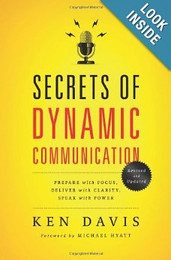
Book: Secrets of Dynamic Communication

When I went to college, I majored in Biblical Studies and minored in Speech. Obviously, I had a plan for what I would be in the future: someone who talk a lot. In Roy Buckelew and Steve Phillips at Ouachita, I was exposed to some of the best guidance in communication that I could imagine. So, I was interested in to pick up the revised version of Ken Davis’ Secrets of Dynamic Communication. I have read the old version, but “updated” sounded good to me.

Image 1I was greatly concerned that Secrets of Dynamic Communication would have been “updated” into an extended commercial for the SCORRE Conferences that Davis and Michael Hyatt do, and am pleased to report that it does not. While the conferences are based on the methods in Secrets, one should consider the book as primary. If you will read it, practice, and implement what you read, then attending a conference would be fun and helpful, but not critical. The conference would be awesome, but most of us can afford to buy a book. I think the conferences are beyond affordable for me.

On to the content:

Davis has made a living communicating, and he started before you could tweet/FB/Youtube your way to fame and a platform. He had to be good at it, and good at it in various venues. The overall method demonstrated in Secrets of Dynamic Communication is about focusing your efforts on the subject and then presenting it well.

This is a helpful method. Too often, speakers aim at nothing, and still hit it full on. The key secret to communication is focus, and that is the foundation of the SCORRE method detailed in Davis’ book.

Davis writes clearly and practically. Secrets of Dynamic Communication is not a book for the communications theorist. There is no detailing of interference incidence or measurement of transmission. Instead, Davis focuses on how you can know you were heard and how you can eliminate what keeps people from listening.

This is an immensely practical book, with just a few drawbacks. The biggest is that I would like to see a couple of basic online resources connected to the book. SCORRE uses a simple template for development of a speech, and I think it would be nice to place a downloadable template online. There’s a blank one in the back of the book, but you’re not likely to cut it out and duplicate it.

Additionally, I would love to see an online resource section with video links to illustrate the material. While I know that would potentially change and become obsolete, it would still be helpful starting point.

In all, though, this is a handy first-step into developing public presentation skills. On the homeschool front, high school oral communications classes could use this as their text on delivery of speeches.

I received a copy of this book from Booksneeze in exchange for the review.

Wednesday Wanderings: Gibeonites

The children’s lesson skips from Ai to the defeat of Adoni-Bezek and his coalition in Joshua 10. There is no examination of the Gibeonite Deception narrative in Joshua 9, which makes sense for a kid-level lesson.

There are a couple of points in the discussion of this deception worth noting. One is this: decision-makers who are in a hurry to make a decision and not worried about getting it right will get it wrong. Another is this: bad leadership leads to angry followers. Keep that in mind when you are ‘in charge:’ there is a responsibility to get it right.

Another aspect here is that we should pay attention to what God says and look beyond basic appearances. If you don’t get that yet, you really haven’t read the Bible at all, have you? God looks deeper. So should we. When we cannot, we have to trust God, not our own ideas.

What I do want to highlight here, though, is an interesting note:

Joshua 9:17 tells us that the Israelites are a three day journey from the Gibeonites. That is the time it takes to cover the distance and investigate the situation.

Now, take a look at Joshua 10:9. Marching through the night, the Israelites make it to Gibeon in one day. They show up in a hurry.

So that comes to this question: how much of a hurry to help your friends do you get into?

Because here, Joshua demonstrates that God’s people are quicker to help than they are to judge. Judgment does come—wrong is punished, but help is at hand far quicker.

Think about that next time you are in the mood to pounce on someone’s errors. Are you willing to help thrice as fast?

Then, we cover the sun standing still in the sky. Please, first of all, stop forwarding the email that NASA has proven that this happened. NASA has never done such a thing—and when we forward emails that sound cool but are false, then we look stupid and not faithful.

There is no viable naturalistic explanation for Joshua 10:13. Either God did exactly as the text said or not, but we cannot explain how it happened. There are some efforts to make this about weather or enthusiasm, but I just don’t get it.

Last comment: I really, really want to find a copy of the Book of Jashar. Seriously, how great of an archaeological find would that be?

Tuesday, October 1, 2013

Light, Freedom, Life: John 8

The pager goes off. I stumble off the bed, grab my Motorola Startac, and call in to the phone center. An hour and a half later, I’m at the delivery entrance of a hospital in a non-descript blue van. I meet the technician, who helps me load up, and I’m about to head back to Arkadelphia. In the mirror at the morgue, I see my reflection.

My hair is out of whack, badly. My shirt is buttoned one-off, I’ve forgotten my belt, and my zipper is down. In short, I look more awful than normal. Why?

In the interest of sparing my roommate, I had gotten dressed to respond to the call in the dark. I had done as best I could without any light. I had then driven, in the dark of the early morning hours, without stopping to even think about how I looked. The morgue tech was apparently so used to people looking like death that he said nothing. Quickly, I ducked into the men’s room, straightened my appearance out, and headed down the road.

Light, you see, is a powerful tool. Light reveals the way things are. It may be the way things are in the world around us, or the way we are. Light reveals. Science teaches us that light also disinfects, and experience tells me that bugs and other icky things tend to prefer dark places. Light is wonderful.

Light allows us to walk in freedom as well. This is why open government policies are referred to as “Sunshine Laws.” They expose the deeds that occur in darkness, and most freedom-killing actions occur in the darkness. It is in the dark backrooms that conspiracies of governments and businesses occur; darkness covers the criminal; shadows cloak even the dark hero who rejects the laws. Freedom is crushed from the shadows, from the diners to the beer halls to the counsels of the evil one.

Freedom is crushed by others from the dark, but it is truly destroyed within us from our own darkness. We carry darkness in our own hearts that is hard to overcome, and that darkness oozes out from within to destroy our freedom to follow God. It keeps us bound to our sin, bound to our past, and blind to the Light of the World.

With that freedom shrouded in the darkness, light cannot be life-giving. In courses I don’t remember taking, in grades I know I was in for elementary school, I know we learned that our biological life gets all of its energy from the Sun. I remember reading how astounded scientists were to find life at deep-ocean vents that existed without light, surviving only based on heat. That biology discussion can come later, but suffice it to say that you and I have physical life only because of light.

That life is also maintained and improved by light. Ever walked through a forest so dense it was dark in the daytime? It can be terrifying—I’ve done it. You trip over so many things, you stumble, you crash, you get pains. I would rather spend twenty miles in open country than five in dense forest. It’s just not pleasant. Even worse would be living in a cave with no hope of coming out for an interminable period of time. (There is a documentary coming out soon about a group of Jews who did this to survive the Holocaust. I can’t find the link, but that looks worth seeing.)

Light, freedom, and life. These all tie together with the underlying principle of truth. Truth, from a Bible-centered view, is not a negotiable construct. It is something unchanging, something fundamental. This is something that our modern philosophy thinks can only be found in a few scientific principles and logic rules, like gravity and non-contradiction.

For the Christian, though, truth is known in a person. John 8 gives us the reality: truth is found in Jesus, and if we know Him we have the Truth. The Truth that brings life, the life that brings freedom, the life lived in the light.

This is the message of the Gospel of John: the Light of Christ is greater than the darkness of the world. The Light shines through Jesus. Through the signs of His miracles. Through the Cross. Through the Empty Tomb. This is what John wants us to see: Jesus.

What about our lives? In the midst of a failing nation, in the midst of chaos rising, are we focused on the light? It does not originate from Capitol Hill or the White House. It does not even originate from the church or the family. He is the Origin, and if we as His people are not seeing him as the ever-fixed mark that we follow, what good are we?

Not much good at all.

Light up the world by following the One who is Light, Life, Freedom, and Truth.

Today’s Nerd Note:

John 7:53-8:11. This is a great story. It is a marvelous example of grace and truth: no condemnation, but sin is to be abandoned. It also paints the older Pharisees in a better light.

It’s the only example we have of Jesus during the Incarnation writing. That does not mean He only does so here. Just that we only have this example.

I have preached this passage. I have taught this passage. I have used this passage to bridge tense situations in churches. I have based restoring people and rebuilding fellowship on these exact verses. I love this passage.

But if you have a modern Bible translation, it’s in italics or it’s in brackets or it’s not even there. Why? Because there are some major questions from the science of Biblical textual reconstruction about it. There are some very valid reasons why the experts in original Greek manuscripts would remove this passage.

I agree with Daniel Wallace’s major point that the emotional attachment to this passage is the reason it remains (See The Center for the Study of New Testament Manuscripts through iTunesU or other sources.) I am not quite certain where to go with the academic matters. I see the evidence that would place the passage more in the Synoptics, and in a vacuum would likely print Bibles with the passage definitely set aside as material possible, rather than material definite.

Yet we do not do Biblical study in a vacuum. Theology bears weight on the methods we bring to the text, even though the text itself informs theology. There is no theology in this, the pericopae adulterae that is divergent from the mainstream of theology in the rest of the life of Christ.

There is also the question of our theology of Bible transmission and preservation. In all, I know that the Greek nerd in me says to excise the passage. My favorite Early Church Father, Chrysostom, is one of many who skip straight from John 7:52 to John 8:12. (actually, everybody but Didymus the Blind do that, and Didymus doesn’t quote the story quite the same.)

But I’m vested here, emotionally, and wonder if we hurt ourselves theologically by claiming that the church had a faulty text for a thousand years and we finally fixed it. I’m uncertain, and I’m certainly uncommitted. If I were preaching through John, I would preach this passage and likely not fully address this unless someone asked.

To-Do Lists

 A to-do list is a great thing.  However, it's predicated on the assumption that you will get everything written down. And that you will...