Monday, September 1, 2014

Sermon Recap for August 31

Good Afternoon! Because of the VBS wrap-up (Good Job, Ryan!) Sunday evening, we have one sermon. Next week we’ll also have one sermon, because we’ll have hamburgers and fellowship Sunday night.

Also, I have switched organizational motifs for sermon preparation. I hope it makes for getting to application points clearer. You may not even notice in the listening, but it will be evident in the outlines that are posted here.

Aug 31: Dry Bones or Living Spirit? Ezekiel 37


Outline:

I.  Front Porch: God alone can bring life to the dead

A. Ezekiel 37

     B. Our situation, our need

II. Entryway: What is going on in this world?

     A. Division in the church

     B. Community angst

     C. Family concerns

     D. National problems


III.  Hallway: Ezekiel's prophetic years in the exile

     A. Ezekiel: early exile, probably prophesying after Jerusalem's fall though

     B. 575 BC...ish

     C.


V. Kitchen: The Word of the Lord brings the Spirit of the Lord who brings life

     A. Death is the natural result of life :)

     B. What we can do is proclaim the Word

     C. At this, we fall on God's mercy

     D. The Spirit of the Lord brings life

     E. The Spirit follows the Word

VI.  Dining Room (personal growth)/Living Room (immediate life application)

     A. DR: Humility, reliance on the Word

     B. LR: Grow through studying with others

     C. LR: be willing to share the Word with others--your life is a foundation, not a complete proclamation

VII. The Door: wide world impact

     A. All we can do is structure bones

     B. While there are bones to keep in order through the law, culture, our real goal is proclaim the Word

     C. That opens the door for the Spirit to work

     D. We cannot determine who the Spirit can and cannot work through

     E. We must stop trying to pick winners and especially decide who loses

VIII.  The Back Porch:

     A. As we go: carry the Word and proclaim it

     B. because God alone can bring life to the dead, through the Spirit who follows the Word


Concluding Notes:

1. I do have the rough audio of Sunday Night’s Q&A session, but I’m not sure yet that it’s useful for posting.

2. I am not sure how to improve video quality with the current equipment.

3. If you want to subscribe, here’s a list:

A. iTunes for audio subscription link is here.

B. General Audio RSS feed for other programs is here.

C. If you’re a Stitcher User, the link is here

D. For Vimeo Video, subscribe to this channel: https://vimeo.com/channels/almyrafbc

E. For Youtube Video, subscribe here: https://www.youtube.com/user/dheagle93/

4. Yes, I think I’m not getting a lot of plays on each service or hits on each blog, but in total it’s a decent reach. A social media expert might suggest changes, but this is free-to-cheap, where I have to live right now.


5. Each blog has a “Follow” button and a “Subscribe via Email” option


6. Follow on Facebook: Doug’s Page or the First Baptist Almyra Page

Thursday, August 28, 2014

Cows or Commitment? Deuteronomy 9

In Summary: By now, you know the drill for Deuteronomy, so I’ll spare you the background data. Deuteronomy 9 gives us Moses recounting some of the sins of the people of Israel in the Exodus, especially during the time around Mount Horeb. Horeb is another name for Mount Sinai, so this is about the feasting that occurred during the time Moses received the Ten Commandments.

That aspect is brought up here, and some of the other times when the people sinned against God in their behavior. Moses is reminding the people to remember the grace they have received. After all, they have provoked YHWH to wrath many times, even within the first months of freedom from Egypt as they did at Horeb.

Why did they rebel even then? Perhaps it was because, like so many of us, the people of Israel were quick to forget. They were quick to forget the big things God had done for them, but even quicker to forget the little ones. Think about the little things: providence in sustaining creation; grace for all the little moments; wisdom in the universe. All in all, God is quite gracious to us all, even without doing any major things, like parting the Red Sea or giving you anything on your “wish list” of life. (Notwithstanding the problems with the “wish list” method of prayer.)
In Focus: The critical moment in this saga is the construction of the Golden Calf. (Deuteronomy 9:16) The Israelites, quite accustomed to having an idol or two around, chose to construct a metallic representation of God. While the nerds will debate whether they Calf was meant to represent God or simply to represent what God was riding upon, the overall action was sinful. It involved trading the command to wait and worship, to trust the unseen, for the ease of worshiping the visible. Trading patience for immediate gratification.

The Israelites chose to sanctify their wealth to idolatry. This is an age-old problem, and one that God is consistently against. The Israelites did it, and the result was the loss of God’s Word as carved by His Hand. Moses through this chapter links the idolatry directly through to the rebellions right up to the refusal to take the promised land.

In Practice: Today’s people, though, never worry with idolatry, right? We, especially those within the church, never carve out golden calves, do we?

Perhaps we do not do so quite so plainly, but we must consider something. How often do we take our wealth and give it over to the worship of something other than God? Not a full-out bow down, most likely, but a diversion of our hearts and cares from obeying what God has said. We do this because it is convenient to do so. We can worship this for a little while, chase after that, and then come back to God. He’s a God of grace and mercy, right?

Except we need to remember that there is only one God, and the God of grace and mercy is also the God of righteous judgment. He will judge sin, He will be provoked to wrath. Especially when we treat Him as if we should be able to pick and choose our commitments.

This is the essence of our problem with idolatry: we want gods that we can contribute to, because by contributing, we maintain control. If it’s my gold that made my god, then I’m in charge. Even if his rules are a little challenging, because I’m the one behind my idol, I can define the exceptions. And then use the rules to direct you.

When God is unseen, though, He is also uncontrolled. We have to follow what He says, do it His way. That’s not always easy. And most of us prefer the ability to have cows to the challenge of having commitment.

But that’s a choice that needs to change.

In Nerdiness: Don’t overplay the presence of the word “today” in Deuteronomy 9:1. That would put this statement, Moses’ death, and the crossing of the Jordan all in one day. Take it more as a “in these days” or a general time reference. Yes, that also bears backwards on Moses’ use of the same word for “day” in Genesis 1.

But that’s another post.

Wednesday, August 27, 2014

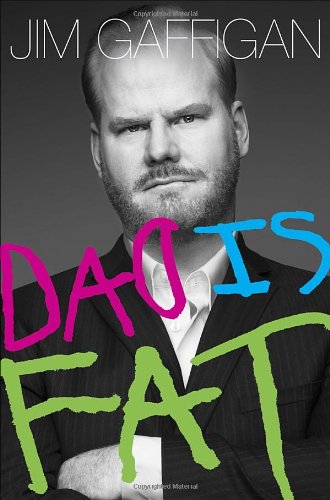
Book: Dad is Fat

One of the free books for blogging groups I have been plundering over the years expanded their offerings. I started with them to get free books with spiritual value, but then they expanded the program to offer free books from their parent company. So, Blogging for Books has more stuff from Random House. As a result, I thought I would branch out and read…a book by a comedian. For fun.

What do you get when you take a comedic routine and put it in print? You get Jim Gafffigan’s Dad is Fat. Actually, you have to add in a few stories and ideas that the typical audience attention span could not hold through, so it’s a bit better than the video of live.

It certainly helps to have heard a bit of Gaffigan and his delivery, because hearing this with the hesitations or filling in the facial expressions improves the funny.

Some folks don’t get it. They may be too serious about parenthood, or too serious about life, and it’s just not funny. Others may be seeking a more cerebral type of humor. This is not that cerebral. It’s just finding the funny in parent life

Well, parent life in New York City. What kind of goober keeps five kids in a five-story walk up? Dude, move to the South, live in the country, and let the kids run wild in the woods. You’ll have plenty of material for the next book that way.

Anyway, the stories are generally family-friendly so there’s nothing to embarrass you if your pastor finds this book on your kitchen table. Nor is there any preachiness, in case your atheist friend comes in right after your pastor.

I like it. It’s funny, short stories, with the connective theme of “This is what I thought about…now.”

Grab a copy and lighten up.

Free book in exchange for the review.

Tuesday, August 26, 2014

Four Last Words: Colossians 4

In Summary: We come to the end of Colossians, and we have barely scratched its surface. There is an abundance of useful theology in these four short chapters, but the calendar turns on, and so must we.

As is expected in Paul’s letters, this last chapter includes his personal greetings. Take note, especially, in 4:11 where Paul highlights that very few workers for the kingdom of God have come from the circumcision. This is likely a reference to those who advocated mandatory circumcision for new believers, pushing them to come to obey the Law in place of the Gospel. Legalism is a trap from which few escape with their faith intact: those who escape rule-keeping often abandon all semblance of involvement to avoid being shackled again.

Another point of interest in this chapter is 4:14 and the mention of “Luke, the beloved physician.” It is from this verse that we take the identity and profession of Luke. Archippus is apparently a leader of the church (4:17), and he needs to step up to the line and handle the work. It’s a challenge for any, and he needs to take heed of his responsibility.

4:5 is the key verse, though, as Paul wraps up his content for the Colossian church. He instructs them to conduct themselves with wisdom and to make the most of the opportunity. We see that something has developed here: a separation between the Christians and the “outside” area. This idea exists in some of the other epistles, but is most pronounced here. Paul wants the church to be effective in connections to the wider world, but not to lose their wisdom in dealing with them.

Overall, though, we are wrapping up a letter intended to combat heresy while still commending Christian morality and right belief. It’s a tricky spot to be in.

In Focus:
That tricky spot brings us to our focus point, Paul’s last words to the Colossians. They are “grace be with you.” In Greek, it’s a slightly different four words, because you have a definite article and no verb: “ἡ χαρις μεθʼὑμων.” Literally, like a newbie Greek student, “the grace with you.” What do we take here?

First, we add the verb so that it makes sense in English. Grace be with you, or perhaps it should “May grace be with you,” not unlike a standard farewell statement. There is no reason for unreadable English for the sake of literalness—fidelity in translation is to meaning, not structure. Structure matters as it affects meaning.

Second, we note what Paul wants to leave the church with. Not a proclamation of this truth or a refutation of that lie, but a blessing. The blessing of grace. Whose grace? What grace?

This is where I think the structures helps us with the meaning: “the grace with you.” “The grace.” Look hard at that: what is “the grace?” For Paul, it is the summary of what God has done. It is God’s grace, shown through Christ Jesus, Lord of All. That’s the grace Paul commends and hopes will be with the Colossians. At the end of the controversy and the greetings, the rebukes and the encouragements, there’s one thing to hold onto: grace.

In Practice:
Well, then, what do I do about this?

1. In all controversies among Christians, seek grace. That’s a big deal. Grace is there for all parties—but sometimes grace doesn’t look like we assume it does. It is not grace to shelter abusers and expose people to excessive risks from wolves. That’s not grace: grace allows God to be seen working to restore the fallen as they work through the consequences of their actions. Grace should be shown to those who are hurt by trying to prevent further harm.

2. In all relationships, we show grace. Extend love, time, and forgiveness. Too often we push for an immediate response and then we hit back because a person responded badly to our complaints. What about cutting a few minutes of slack for someone to think through? Try that next time you are arguing with a spouse, or demanding answers from a child.

3. Within our churches, be places of grace. Show grace, be about grace. Dwell on the positives and the good things God has done. We proclaim the truth of His holiness and His grace. If all you focus on in church is how people screw up and not about how God restores, then you might consider the need for a little more grace.

In Nerdiness: Three quick nerd points:

1. Lost letter? Colossians 4:16 brings up the letter from Laodicea, and the need to share this one with Laodicea. We don’t have that one, and it’s likely we don’t have others that Paul wrote. I recommend Randy Richards’ book on Paul and First Century Letter Writing to dig more into it. The other theory is the “everything must connect!” theory. I’m not a fan: this view suggests that we must have the Laodicean letter, so let’s pick another one of the Biblical epistles to be it. It’s based on an assumption that nothing relevant to the Bible isn’t there. A read-through makes it clear that’s not the case.

2. Mark? Colossians 4:10 shows us Mark back on the missionary trail.

3. Onesimus? Colossians 4:9 connects this book to Philemon. Even here, Paul is scuttling the Roman social order by elevating the slave Onesimus to “one of you” and “our faithful brother.”

Monday, August 25, 2014

Sermon Wrap-Up for August 24

Good morning! Here are the sermon videos and audio links from this weekend.

Morning Sermon: Psalm 137

August 24 AM: Psalm 137

1. Live in exile? Yes, you do...consider the horror of loss, the viciousness of the World

2. Will you forget what is truly home?

3. A better form of revenge.


Evening Sermon: Jeremiah 43

August 24 PM: Jeremiah 43

1. Don't ask if you won't listen

2. No, seriously.

3. Great, now you've destroyed another kingdom.

4. Seek in obedience.


Concluding Notes:

1. I do have the rough audio of Sunday Night’s Q&A session, but I’m not sure yet that it’s useful for posting.

2. I am not sure how to improve video quality with the current equipment.

3. If you want to subscribe, here’s a list:

A. iTunes for audio subscription link is here.

B. General Audio RSS feed for other programs is here.

C. If you’re a Stitcher User, the link is here

D. For Vimeo Video, subscribe to this channel: https://vimeo.com/channels/almyrafbc

E. For Youtube Video, subscribe here: https://www.youtube.com/user/dheagle93/

4. Yes, I think I’m not getting a lot of plays on each service or hits on each blog, but in total it’s a decent reach. A social media expert might suggest changes, but this is free-to-cheap, where I have to live right now.


5. Each blog has a “Follow” button and a “Subscribe via Email” option


6. Follow on Facebook: Doug’s Page or the First Baptist Almyra Page

Saturday, August 23, 2014

Book: Blessed are the Balanced

<---Don’t look now, but there’s another book sneaking up on us!


Blessed are the Balanced is a book that should be required reading for seminary students. More clearly, the cost of a copy should be factored into the application fee and be mandatory reading before you ever take a seminary class, and then again every summer or major school break. I say this as someone who has just finished an overextended journey from first class in seminary to graduate, and had to admit that I was not emotionally and spiritually ready to jump to the next degree.

If you are headed to seminary or in seminary, you need this book. If you are teaching seminary students, you need this book so that you can connect them with the needs they are ignorant of, and so that you can shape a bit of your requirements around those needs.

Now that the rhetoric has passed, let’s actually examine the material. First, BatB is written by two seminary faculty members. They are acutely aware of the pitfalls that they have experienced and that they see in students.

The concept in this book is simple: seminary studies are intended to deepen faith and understanding. This time should both broaden our knowledge and ignite our passion to walk with Jesus. Taken together, these two aspects develop who we are as ministers, even as we follow the Lord into life outside of seminary.

Included in this blessedly thin volume are both ideas and practices worth adopting for the seminary student. Blessedly thin? You’re going to read a lot, and adding only 125 pages is a blessing. The ideas deal with the right approach to wisdom and knowledge.

The practices are varied. While some are ancient spiritual practices that might be too mystical for some, overall these are quite valuable. Even if one has concerns about embracing every one of the classical spiritual disciplines, the suggested practices remain quite helpful.

Given that my first attempt to complete seminary ended in tears and a dry faith, I am perhaps more positive about this work than others will be. Retrospectively, I think it would have been a great read for me in the summer of 2002—so if the next development in technology could be a TARDIS, I’ll drop off a copy with the Doug of those days. He needs this book.

Book provided by the publisher, Kregel Academic, in exchange for the review. Kregel Academic has published some of my favorite books in recent years, as well as publishing the Phillips Commentary Series.

Friday, August 22, 2014

And we will thrive: Deuteronomy 8

In Summary: The people of Israel remain, as they have been for several chapters, loaded up and ready to enter the Promised Land. Deuteronomy contains the recounting of the covenant. A few sources I have read suggest that this is the “official” version of the covenant between Israel and YHWH, their God. The earlier books of the Pentateuch have contained narrative and statistics, primarily, or the early and scattered expression of the Law. This gains a little credence when we look at the back half of Exodus, for example, and see how much of this one-time use material: there is no need to build another Tabernacle, Ark, or Altar. The construction information is not part of God’s long-term covenant with Israel: these items serve as evidence of the heritage of the covenant.

I will note this: I have read this idea hinted at in a source or two, but I can’t put my hand on those sources right now. I think there are some issues with it, but it’s a moderately workable concept.

Alongside the heritage items that the people made in obedience, as if part of a precursor to the long-lasting covenant for the nation, we have Deuteronomy 8. This chapter gives a retelling of God’s provision for the people of Israel in the wilderness as well as summarizing what type of land that YHWH their God was bringing them into. It was a good land (Deuteronomy 8:7). Essentially, you have the setup here that God has proven, through durable shoes and clothes, through manna and water, that He is able to deliver His side of the covenant.

He also demonstrated, through protecting the Israelites from the dangers of the desert and through destroying their enemies, that He is not a God to be disregarded. If the people disdain the covenant, if they betray their word to the Lord God of Hosts, then the land will become their grave. They will perish there, not because God is not able but because they did not listen to Him. After all, He is promising a land with water and wheat and barley and vines and figs…well, elsewhere described as flowing with milk and honey.

In Focus: We ought not pass through this without addressing Deuteronomy 8:3. Note the contrasts in this verse, that God both allowed hunger and provided food to the Israelites. He did both things so that they would be humble and recognize this important truth: man does not live by bread alone. Man, rightly seen here as “all of humanity,” lives by everything that proceeds from the mouth of YHWH.

Consider this. All of the issues faced by Israel throughout the Exodus and Wanderings period were intentional, to teach them to rely on God. Further, they were to drive home the point that God is above all things, it is His word that brings results. Not even man’s whining brings results.

In Practice: This concept, though, that we rely more on the Word of God than on food has been, and can be again, perilously misapplied. The concept here is not that we never need to eat. The concept is not that we are able to neglect the effects of the Curse from Genesis 3: still we must battle the ground and pour forth the sweat of our brow to earn a living.

That does not mean, though, that life is consumed with making a living. What has God said? We have a record of His revelation, and it’s not just the book of Revelation within the Bible. It is the totality thereof, the whole revelation of God found in its pages. We live for Him. Further, we must note that it is His continued action of grace that sustains the world.

Even as we learn the processes by which He does so, like gravitational fields and nucleic forces, we keep in mind that the hand of God exceeds all the power of natural law. It is possible for Him to work within it or outside of it. And if He leaves us to the consequences of those laws, as they have been knocked toward chaos by sin, then it is part of our learning humility before Him.

So we practice humility, that we may be humble enough not to realize we are humble. And a good way to get there? Serve others, especially without regard to the recompense they may give you. I daresay that might include serving the rich and the poor—and taking no notice of their abilities or resources, only their needs. Or serving the “important” and the “unimportant” while making certain that they are each equally important in your eyes. Or standing with all those who need help, regardless of their circumstances, or even if we know them well. Humility serves.

In Nerdiness: Take a quick nerd-eye look at Deuteronomy 8:9. Not only is there abundant food in the land, but there are metallurgical resources! Both copper and iron are to be found in the Promised Land. This prepares Israel to work through the Bronze Age, which the region is in during the Exodus, and on into the rising Iron Age which is soon to come. This will enable the Israelites not only to develop the necessary weapons to contend with their neighbors, but also advance their agricultural techniques and construct musical instruments.

This mention is worth noting for a couple of reasons. The first is that it acknowledges the antiquity of the occupation: copper is mentioned as a mined item, which shows industrial involvement akin to archaeological and historical records of the Bronze Age. Iron is mentioned as being “in the rocks,” and the earliest iron usage was from iron meteorites, leading to industrial development. The land is described as one would expect for an occupation fitting between 1400-1200 BC, in little details that would one would not likely create out of thin air.

Second, it shows that the land is good for more than just survival for the people. Not only will they live, but they will thrive.

Book: Human Raised

Human Raised Nurturing Connection, Curiosity & Lifelong Learning in the Age of AI Dana Suskind, MD 310 pp., hardcover Dutton, an imprint...