Wednesday, February 25, 2015

Book: The Art of Work by @jeffgoins

book

(Click the image to get more information about the book in pre-sale and bonuses available for it.)

In the modern American Christian world, there are two major schools of thought about finding your life’s work. Both views have their proponents and books, and both have positives to commend them to you. The first view is that one needs to absolutely only ever obey God. The other view is that one needs to “find yourself” and go with the flow of the universe. This latter view is often Christianized by attaching random Bible verses.

It’s also so much fluffy nonsense.

The other view, of only obeying God, is a no-brainer. If you are a Christian, then you have made that your life’s goal: obey God in all ways and all things. One is then back to the original question: what do I do with my life? How do we find those things that we best glorify God by doing?

Into that conversation comes The Art of Work by Jeff Goins. Goins acknowledges the need to find personal fulfillment in work, but bases it not in self-satisfaction but in becoming what God meant you to become, doing what you were meant to do.

A note is due here about the idea of “work” for the purposes of this book. It’s not just about where you punch a time clock. It’s about all the things we do—both for profit and for living. Goins presents some ideas here about how to help those two things mesh.

Goins challenges the reader to examine just how they are energized in living life. He presents several ways to work through shifting life to a more fulfilling view. It all starts with the core: determine that what you want in life is not the same as what everyone else wants. Lean into those desires, not into the template of wealth or self-actualization that the world imprints for you.

Is this work perfect? Of course not. For the most part, the imperfections are opportunities for the reader. Goins has chosen examples and testimonies that highlight the extremes that are possible in this world, both depths to rise from and heights to soar to. That many of us may not achieve as much should be balanced by the reality that most of us are not near as low, either. Further, if he spelled out exactly what you should do, you would live his dream and not yours. Seems like that misses the point, doesn’t it?

All told, Goins makes excellent points in The Art of Work. Further, he uses Biblical events and passages without doing violence to their context. It’s not a Sunday School book—this is not a Bible study work, it’s a personal development book. But it is worth your time.

Disclaimer? Not really. I’ve met the author, and he’s a nice guy. Of course, I’ve met other people whose books I don’t like, so meeting me doesn’t guarantee a good review. This is worth your time.

Tuesday, February 24, 2015

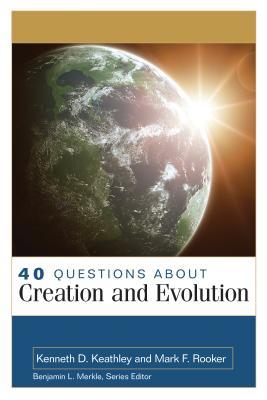
Book: 40 Questions about Creation and Evolution

Book Blitz gets deeply theological.

40 Questions about Creation and Evolutions by Kenneth KeathleyWhen it comes to the debate about the origin of humanity or the origin of the universe, one has two basic options. You can start with a belief in a supernatural possible origin, or you can start without one. If you start with a belief that there is no possible supernatural origin, then that’s where your search ends. The universe is what it is, it happened how it happened, and we’re done here.

If you start with a belief in the possibility of the supernatural, then you have further ideas to examine. For example, one must determine which supernatural accounting should be considered. One must determine how the supernatural interacts with the scientifically observed and tested. These are the questions that feed into Kregel Academic’s 40 Questions about Creation and Evolution.

The first observation on this work is that the authors are theology and Old Testament professors. This demonstrates that the work is aimed at answering questions based in the Bible account of the origin of the universe and humanity. I think the work would benefit from adding an author whose expertise is science, but the authors have well-researched and cited scientific issues where appropriate.

The second observation is that this is not really a book about science at all. It is more appropriately considered a book about whether or not the Biblical account can be interpreted in various ways. Is the “day-age” theory tenable based on the text? What of “intelligent design”? How much is “Darwinism” science and how much is it religious/philosophical? These are the questions treated here.

The third observation is that in the times where this book treats with science, it does attempt to present even-handed evidences. For example, geological examples are presented that defy easy explanation in the typical young-earth viewpoint as well as those that support that viewpoint. Overall, the science conclusion appears to come back to an undecided viewpoint. The authors promote the idea that science cannot give a fully conclusive answer and that one must find it in examining the Biblical account.

Where does this fit into the typical reading program? It’s a pretty serious read. 400 pages of theology, Biblical Studies, and science. Fortunately, it does include footnotes :) but overall, you’re not going to read this for fun on the weekends. (Unless your nerd-level is as high as mine.) However, for those trying to wrestle with how Christian Scripture and the origin of the world work together, this is worth your time. It’s also worth it for anyone preparing an in-depth study on Genesis 1 and 2.

Free book in exchange for the review.

In the Future: Luke 21

In Summary:

Luke 21 opens with what is probably the most famous of all Jesus’ teaching on giving. This is the story of the Widow’s Mite, where a widow gives her small amount at the Temple. She is contrasted with the religiously self-important, who give greater gross amounts, but do it for the publicity. Additionally, she has put a larger percentage of her resources—without divine support, she will be in great need. The important folks? These gave from what they did not need.

After observing the giving at the Temple, Jesus goes on to speak of the end of time. His return will come after a great deal of chaos and destruction. One challenge in using this chapter to foretell a specific date—or even era—is that two major events are intermingled here. The return of Christ and the end of the ages is the major one, but secondarily included is the destruction of Jerusalem, likely at the hands of the Romans. (Or, perhaps, the destruction of Jerusalem at the end of time. You get the challenge.)

As always, the main issue in “end of the age” timing is the imminence of the return of Christ. It’s clear enough that it could be almost any time. Be obedient. Be ready.

In Focus:

Rather than putting a few verses under focus today, let us consider the context of this entire chapter. Many times we have heard sermons about giving based on the Widow’s Mite. I will acknowledge the virtue of giving with regard only for the glory of God. Those who give without regard to the opinions of others or their own comfort are more often blessed than those who focus on logic in giving.

Looking at the context, have you ever considered how the whole section is connected? Jesus begins to teach about the impending doom and transition to eternity after seeing the Widow and her giving. This tells us that, whether we like it or not, the events observed and the teaching given are related. Jesus did not see the Widow and say “Well, changing the subject…”

If these are connected, then what is the connection? The connection is this: why hold on to material wealth in light of eternity? And why give to build buildings, even the Temple, what will be destroyed?

In Practice:

Where is the practical look of this going? You might think it’s heading to “mail a check to your church!” Or even more likely, “Mail a check to your pastor!” (Or pastor-blogger! Address is available…)

That’s not the direction I want to head. If you are a Christian, you have a responsibility to honor God and support the work of the Kingdom through the church you are a part of. That’s not what is in view here—Jewish Law commanded the giving to support daily existence of synagogues and teachers. While that command is subsumed under grace, we still bear that responsibility for the church today. The giving in view was the extra giving, the giving for something greater and extra.

Instead, I would challenge us all to consider this: in light of eternity, what good is any of our spending? This includes how your local church spends its money. Are we spending it on matters that carry through? On growing fruit? On honoring God?

Or is it all going to stuff that will go away? That big, beautiful church building? Guess what? It’s doomed. Fancy car for your pastor? Destroyed. Copies of the Word of God for the multitudes? That carries forward, for the Word of the Lord endures forever. Hungry fed? That’s worth it.

Are there needs for administrative or helpful tools like buildings or employees…sure. But keep it perspective. If the Widow is going to give her Mite, then she shouldn’t be doing it just to build a building that’s destined for destruction. Let it go to something of value.

In Nerdiness: 

Luke 21:24 speaks of “the time of the Gentiles.” When are those? Some would suggest that this was the Roman domination until the modern nation of Israel. Others suggest that the “time of the Gentiles” continues even now, as Jerusalem continues to be ruled not by the Jewish people but in all sorts of chaos.

The reality? We don’t know for certain, but I would suggest that the “time of the Gentiles” continues in Jerusalem to this day. I’m not the perfect interpreter of prophecy, but I think there remains a future restoration of Jerusalem. In the long run, there will be a time when Jerusalem will not have to consider the opinions of Gentiles. But that is not yet.


Could it be soon? It could. Which is why the ultimate eschatological plan is always the same: be ready. The Lord is coming soon.

Monday, February 23, 2015

Book: The Leadership Handbook

Book blitz continues today…just a few more days and it’s all over with.

John Maxwell has been writing on leadership since I was in junior high. He’s been at it awhile now, because I’m getting old. His current work is called The Leadership Handbook. The question for a new Maxwell book on leadership is not whether or not the content is quality. That much is assured.

The real question is: if I already have Maxwell’s other books, do I need this one?

Because if you haven’t read up on leadership, you absolutely need to. This one, by boiling down the principles in most of Maxwell’s writings, is a good introduction. I like it better than his 21 Laws book, though that is a matter of preference.

Why is this a good starting point?

Each chapter presents a summary statement of leadership, then gives three ideas to expand it. After that, the chapter presents application exercises and concludes with a one-paragraph “mentoring moment” that encapsulates the ideas from that chapter.

The 26 ideas presented are excellent. There is the unfortunate inclusion of Perry Noble as a positive example of leadership, but Maxwell is examining leadership. Even the aggravating can demonstrate leadership. Leaving aside whether all of Maxwell’s other examples have used their leadership well—I think Noble, for example, has misapplied the idea of rising above criticism—the principles are still useful.

Now, I think this is definitely useful for new readers of leadership principles. Is it of any use to those who have read Maxwell’s prior books?

Yes, I find it useful. First, there are places within this book that Maxwell provides limiting parameters for his leadership principles. While one could read some of his earlier works and justify a self-absorbed leadership, Maxwell is clear in this work that this is not acceptable.

Second, The Leadership Handbook breaks down into nice group study segments. A six-month internship would couple well with reading through a chapter per week.

With the reservation that not every leader that was doing well when Maxwell did his research is still doing well, I can recommend this book to the student of leadership, whether new to the study or long-traveled.

I did receive a copy of this book in exchange for the review.

Sermon Recap for February 22

Good morning! Here are the sermons from yesterday. For the next several days, I’ll be posting a book review every day as well as normal posting. If you’re subscribed through MailChimp, then you will still only get one email.

Morning Sermon: The Treasure Matthew 6 (audio)

I. Beware of practicing righteousness _____________

II. Do not give __________________

III. Do not pray to be heard _______

IV. Do not fast___________________

V. Store your treasure rightly and your ______ will follow

Evening Sermon: Romans 5:8 (audio)


Extended morning notes:

The Treasure 92744.75

Matthew 6:1-6, 16-21

Ever-fixed mark: The Treasure of Life is found in the grace-given relationship we have with God.

If I gave you 1 hour to load up and evacuate, never to return, how would you spend it?

A heart check: Where is your heart? Where does your heart lead you? Not sure?

Let me give you a different way to look at it: what do you treasure? Whatever your treasure is, your heart will follow it. If you treasure this earth, your heart will always lead you back to the things of this world.

I. Beware of practicing righteousness to be noticed

Why do we do what we do?

Jesus comes straight to the point: BEWARE!

Why do we do what we do?

II. Do not give to be rewarded

Giving? Press releases? Name plates on pews? (Mueller story?)

Giving? To earn something? Our salvation? The approval of others?

At times, it is tempting to suggest that one should have to give monetarily to the church to have a say in the business affairs…but if we do that, then what purpose are we asking people to give for?

We have to remember: giving, whether to the poor or to the work of the church, is done in response to the grace of God. Not to earn anything.

It is sometimes appropriate to allow others to make note of your giving—if the purpose is to bring greater glory to God and to inspire others. If you are not the one seeking it.

III. Do not pray to be heard by men

Prayer? Why do we pray? We’ve talked about this some of late, and one reason we pray is because it builds our relationship with God.

We are not building our relationship with God through prayer if we spend our time talking for the benefit of others. Or for their applause.

Prayer involves acknowledging His mastery and our weakness. His glory, our need. His purpose as above our own.

IV. Do not fast to gain attention

Fasting? Do we even do that, us food-loving Baptists?

We do—but we never talk about it. A person who tells you about their fasting is ignoring what Jesus says here.

A few side notes about fasting: the purpose of fasting is to focus the time spent on food on strengthening your relationship with God. It is not simply about skipping meals but about where the time and effort for those meals is spent instead. Further, one may refer to “fasting” from other things—from movies, TV, Internet, and so forth. These ideas are valuable but again: if you plastered your Facebook account with “I’m going off Facebook for Lent to fast” then all those “likes” you got? That’s it. You did it to be noticed.

Further, one CANNOT fast from sinful activity. Fasting is a temporary setting aside of something that is acceptable to focus on something greater. If your eating, social media, TV watching are sinful (destroying your body or your relationships with God and His people) then you are not fasting from these. You should be repenting.

Fast. It benefits us to take our focus off the earthly matters around us, to be dependent on God and reliant on Him.

But don’t moot the point by setting up a fasting support group. Further, consider Isaiah’s words about fasting:

6 “Is this not the fast which I choose,

To loosen the bonds of wickedness,

To undo the bands of the yoke,

And to let the oppressed go free

And break every yoke?

7 “Is it not to divide your bread with the hungry

And bring the homeless poor into the house;

When you see the naked, to cover him;

And not to hide yourself from your own flesh? Is 58:6–7.

V. Store your treasure rightly and your heart will follow

Overall—it must come to this decision: What Treasure do we seek?

Most of us spend so much time on earthly treasure.

Apart from a saving relationship with Jesus, we seek the earthly treasures—and sometimes heavenly ones, but we want to earn them.

We cannot. We must accept the gracious gift of God. Salvation is not found by how well we behave, nor how well we do religious things.

It’s not “attained” by impressing the people around us, either.

Only by the blood of Jesus paying for our sins can we be saved.

As we repent of our sins and follow Him.

And then? It’s our joyous opportunity to follow, trusting God with our treasure.

Where is your heart headed?

Saturday, February 21, 2015

Book: Beneath the Forsaken City

Book blitz ventures into the Fantasy World…

I have not read the first book in the Song of Seare series, a fault I will definitely seek to remedy after reading Beneath the Forsaken City. C.E. Laureano has crafted a fantasy world that fits well into the Christian allegory/fantasy genre. It’s not straight allegory like Pilgrim’s Progress, but still carries some of the ideas of Christian life wrapped in a good narrative.

Having not read the first book, I was a tad bit lost as I started on this book. Fortunately, the adventure stands decently on its own. One is not entirely sure what’s going on in the universe of Seare, but I was able to fill in the gaps.

Laureano’s characters, Conor and Aine, are presented well. Further, the “bad guys” are clearly bad—there are no doubts about good and evil. That is a positive for fantasy literature. I would suggest having a quick thumb to the back pages with the pronunciation guide…

How well does the allegory stand up? I find no fault in the theology presented through the allegorical moments. It is, most certainly, not perfect. But overall, one ought not get your theology from fiction anyway. As an illumination of the ideas of grace and commitment to God, this one hits that just fine.

Is it worth reading? Absolutely. I’ll be adding this to the shelf for my kids as they hit middle-school reading ranges. There is action, there is good versus evil, there is romance. Everything that a good movie would have…but it’s in your imagination instead.

Sounds like a win to me.

Free book from the publisher.

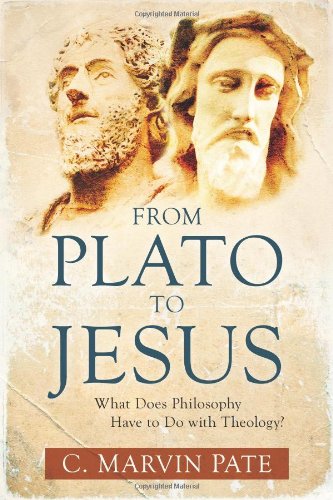
Book: From Plato to Jesus

Book Blitz continues! This book is as far from the last one as I think one can get.

One of the great things about being a book reviewer for Kregel Academic is that they let me have an extra book, of my choice, as a birthday present. I don’t have to hide in a cave with it, I just have to review it. This year, I asked for C. Marvin Pate’s From Plato to Jesus. Dr. Pate is a professor at Ouachita Baptist University’s Pruet School of Christian Studies. (In the dark ages, it was just the Religion Department.) I am an alumnus of OBU, so I try to keep up with all religion publications from the faculty, because it makes me look smart. Dr. Pate’s hard to keep up with—I’m about a dozen behind on his books.

From Plato to Jesus addresses this question: “What does philosophy have to do with theology?” Obviously, Pate feels the answer is more than “Not a blessed thing.” Instead, he develops the extended answer to this question. He traces first the historical development of philosophy. This begins with the Pre-Socratics and carries forward into the contemporary era of philosophy.

He then traces how philosophy underscores our understanding of theology. In this, he highlights areas where poorly-executed philosophy gives us theological problems. I find this section particularly enlightening.

Is this a book for the broad audience? Despite the blessed presence of footnotes instead of endnotes, I must say that it is not, at least not for the casual reader. One is going to need to invest serious intellectual effort into this book.

First, Pate is writing for a more academic discussion. If you’re typically reading at the popular level, be ready to stretch. Second, he assumes some basic familiarity with the principles of philosophy. We should all have some, but many of us may have forgotten them.

Third, Pate assumes a basic understanding of general theology. Again, for his target audience, that’s fine.

To the great credit of the author, as he works through the second section of this book, he follows a fairly standardized format. (Standardized for this book, chapter to chapter.) For each theological issue at hand, Pate provides one potential way to understand it with both theological and philosophical points, then provides the historically contrasting view. Then he provides the view that reads like the better one, with its proponents. By using this format repeatedly, it is easy for the reader to dig into the actual content.

Who should read this book?

This should be on the reading list for most pastor-theologians-teachers and serious students of the Word of God. I am persuaded that we should read at least one heavy-duty book per quarter, one light-duty book per quarter, one biography, and as much else as possible. This fits that heavy-duty need.

Get it. Read it.

Free book for the review from Kregel Academic. Yes, I always like their books.

Book: Human Raised

Human Raised Nurturing Connection, Curiosity & Lifelong Learning in the Age of AI Dana Suskind, MD 310 pp., hardcover Dutton, an imprint...